


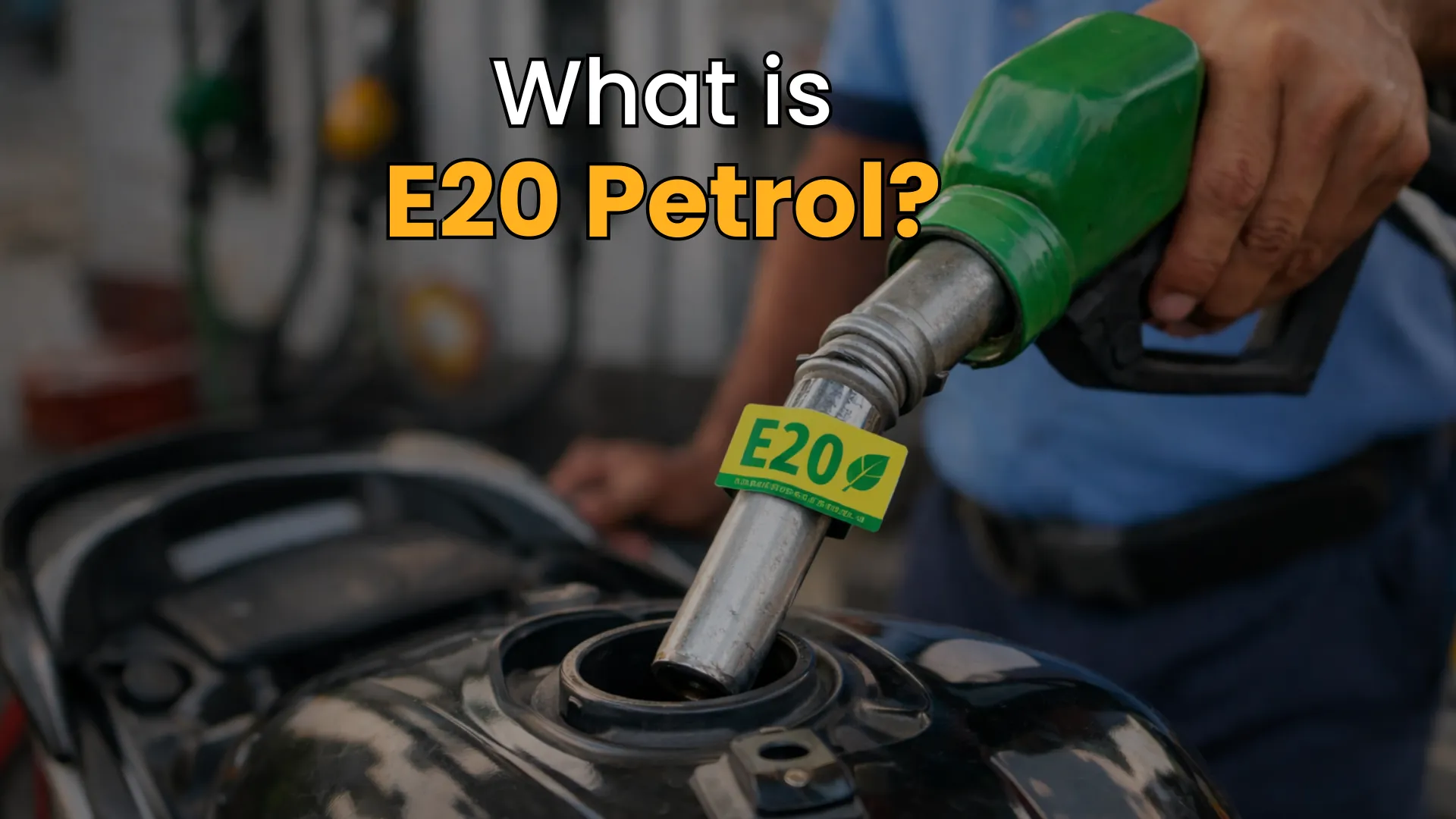
As India accelerates its transition toward cleaner and more sustainable mobility, a key question many vehicle owners are asking today is: What is E20 petrol, and how does it impact everyday usage? E20 petrol is now being rolled out as a new fuel standard across the country, driven by the need to reduce emissions, lower dependence on fossil fuels, and promote renewable energy sources.
As fuel technology evolves, understanding E20 petrol is no longer optional but essential to make informed decisions about vehicle usage and maintenance. This comprehensive guide explains all you need to know about E20 petrol, including its meaning, working, benefits, challenges, and its relevance in modern vehicles.
What is E20 Petrol?
E20 petrol is a form of ethanol-blended fuel that consists of:
- 20% ethanol (biofuel)
- 80% petrol (fossil fuel)
| Fuel Type | Ethanol % | Petrol % |
| E10 | 10% | 90% |
| E20 | 20% | 80% |
Ethanol is a renewable fuel produced from agricultural feedstocks such as sugarcane, maize, and biomass. Unlike conventional petrol, ethanol contains oxygen, which helps in more complete combustion. India has gradually increased ethanol blending levels over the years:
- E5 → E10 → E20
This phased approach ensures smoother adaptation for both manufacturers and consumers.
Why is India Switching to E20 Petrol?
India’s move toward E20 petrol is not a single-factor decision but is driven by a combination of environmental, economic, and strategic goals.
1. Reducing Dependence on Crude Oil
India imports a significant percentage of its crude oil, making it vulnerable to global price fluctuations & supply disruptions. Ethanol blending reduces this dependency by partially replacing petrol with domestically produced biofuel.
2. Lowering Carbon Emissions
Ethanol burns cleaner than petrol, leading to reduced emissions of:
- Carbon monoxide (CO)
- Unburnt Hydrocarbons (HC)
This is particularly important in urban areas where vehicular pollution is a major contributor to poor air quality.
3. Supporting the Agricultural Sector
The ethanol blending program creates a steady demand for agricultural produce, providing:
- Additional income streams for farmers
- Better utilisation of surplus agricultural produce
- Reduced wastage
4. Promoting Renewable Energy
E20 petrol acts as a bridge fuel, supporting India’s transition toward cleaner mobility while existing internal combustion vehicles remain on the road.
How Does E20 Petrol Work?
E20 petrol functions similarly to standard petrol but has distinct properties due to the presence of ethanol.
1. Higher Oxygen Content
Ethanol’s oxygen content supports more complete combustion, which can:
- Improve combustion efficiency
- Reduce certain exhaust emissions
- Help minimize unburnt fuel residue
2. Energy Content Difference
Ethanol has a lower calorific value than petrol. This means:
- Slightly more fuel may be required to produce the same energy.
- Minor impact on mileage may be observed
3. Engine Adaptation
Modern engines are designed to handle E20 petrol through:
- Advanced fuel injection systems
- Improved engine calibration
- Ethanol-compatible materials
What are the Benefits of E20 Petrol?
As India moves toward cleaner and more sustainable fuel alternatives, understanding the advantages of E20 petrol becomes increasingly important. Introduced as part of the country’s ethanol blending initiative, E20 petrol is designed to reduce environmental impact while supporting energy security and economic growth.
From lowering emissions to promoting renewable resources, the benefits of E20 petrol extend beyond just vehicle performance, making it a key component in the future of mobility.
1. Reduced Emissions
E20 petrol lowers harmful emissions, contributing to improved air quality.
2. Cleaner Engine Performance
Better combustion leads to:
- Reduced carbon deposits
- Cleaner engine components
- Potentially improved engine longevity
3. Reduced Fossil Fuel Dependence
By replacing a portion of petrol with ethanol, India can reduce crude oil imports and improve energy security.
4. Boost to Rural Economy
The ethanol industry supports agriculture, providing economic benefits to farmers and rural communities.
5. Sustainable Mobility Transition
E20 petrol acts as an intermediate step toward greener mobility solutions, helping ease the transition to future technologies.
Is E20 Petrol Mandatory in India?
E20 petrol is being gradually rolled out across India and is expected to become widely available.
Government’s objectives include:
- Standardizing fuel types
- Encouraging cleaner fuel usage
- Supporting long-term sustainability goals
As availability increases, E20 petrol is likely to become default fuel option.
E20 Petrol and Two-Wheelers
Two-wheelers form a major part of India’s vehicle population, making E20 compatibility particularly important.
Key Impacts:
- Reduced emissions on a large scale
- Improved sustainability in daily commuting
- Increased need for compatibility awareness
Modern two-wheelers are being developed to handle ethanol blends more effectively.
E20 Petrol and Suzuki Motorcycles
Suzuki Motorcycle India Pvt. Ltd. is actively supporting India’s transition to cleaner mobility by aligning its product portfolio with the country’s latest fuel standards. All Suzuki two‑wheelers sold in India are E20 compliant, having been engineered to run efficiently on petrol blended with up to 20% ethanol while maintaining reliability and performance.
Through this comprehensive adoption of E20 compatibility, Suzuki reinforces its commitment to environmentally responsible mobility and enables riders to adjust confidently to India’s changing fuel landscape.
Future of E20 Petrol in India
E20 petrol represents a major step toward the future of mobility.
Expected Developments:
- Wider adoption across all regions
- Improved vehicle compatibility
- Better fuel infrastructure
- Greater consumer awareness and acceptance
E20 petrol will continue to play a key role in shaping a cleaner and more sustainable transportation ecosystem.
Conclusion
Understanding what E20 petrol is increasingly important as India transitions toward cleaner and more sustainable mobility solutions. By blending renewable ethanol with conventional petrol, E20 helps reduce emissions, strengthen energy security, and support domestic agriculture.
While older, non‑E20‑compatible vehicles may experience reduced efficiency or durability concerns, modern E20‑compliant vehicles, including Suzuki’s two‑wheeler lineup, are engineered to operate reliably with this fuel. With growing infrastructure and manufacturer readiness, E20 petrol is set to remain India’s standard petrol fuel for the foreseeable future.
