


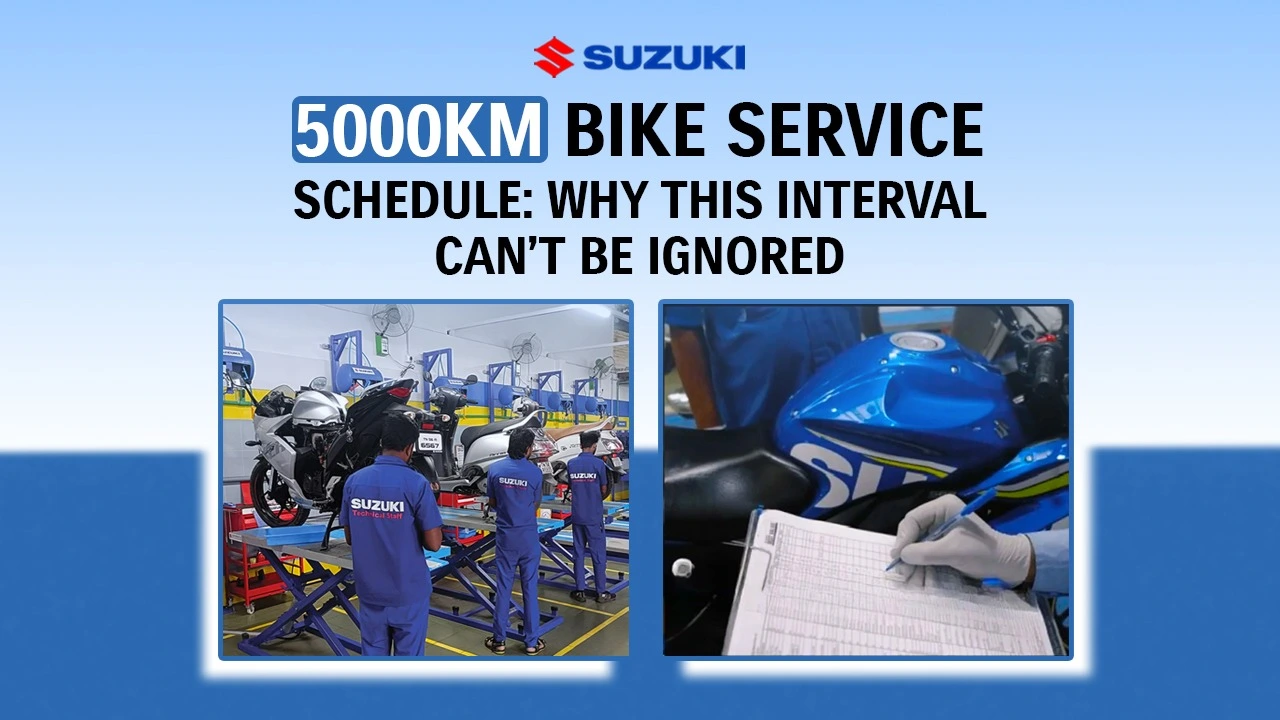
Your odometer just crossed 4,800 km, and you’re thinking, “Can I push it to 6,000? The bike seems fine.” Here’s the uncomfortable truth: by the time your bike “doesn’t seem fine,” internal damage is already happening. Following your bike service schedule isn’t about what you can see; it’s about protecting what you can’t.
Today, we’re breaking down exactly why that 5000km service interval exists, what happens if you skip it, and how this single maintenance habit can add 20,000+ km to your bike’s lifespan.
Understanding the 5000km Bike Service Schedule Milestone
The 5000km interval isn’t arbitrary. Manufacturers like Suzuki have tested their engines for thousands of hours to determine exactly when critical components need attention.
Think of it like this: your engine is running at 3,000-8,000 RPM for extended periods. At highway speeds, your piston travels up and down 100 times per second. After 5,000 km, that’s roughly 150 million cycles. Even the best engineering needs a checkup after that kind of workout.
Why Not 3,000km or 10,000km?
Modern Suzuki engines and improved oil technology allow longer intervals than the old 3,000 km standard. However, most manufacturers set servicing intervals around 5,000 km as the usual period for engine oil changes, balancing engine protection with practical convenience.
Going beyond 5,000 km risks oil breakdown. Extending too far above 5,000 km wastes money on unnecessary services. The 5,000 km bike service schedule hits the sweet spot for most riding conditions.
What Your Manual Actually Says
Check your owner’s manual, and you’ll see service specified as “5,000 km OR 6 months, whichever comes first.” That second part matters enormously but gets ignored by most riders.
Even if you’ve only ridden 2,000 km in six months, you still need service. Why? Engine oil degrades over time regardless of use. Moisture accumulates, additives break down, and acids form from combustion byproducts. Time-based servicing protects low-mileage bikes from these chemical processes.
What Actually Happens During Your 5000km Service
Let’s demystify what mechanics do during your bike service schedule appointment. Understanding the process helps you appreciate why it’s worth the ₹800-₹1,500 investment.
Engine Oil and Filter Replacement
This is the cornerstone of your service. Engine oil serves three critical functions: it lubricates moving parts, cools components, and cleans internal surfaces by suspending contaminants.
After 5,000 km, your oil is contaminated with:
- Microscopic metal particles from engine wear
- Carbon deposits from combustion
- Dust and dirt that bypassed your air filter
- Moisture from temperature cycling
- Acidic compounds from fuel combustion
Fresh oil restores full protection. The oil filter, now saturated with trapped particles, gets replaced to ensure clean oil circulation. Using degraded oil is like asking your engine to run on sandpaper soup, nothing good happens.
Air Filter Inspection and Cleaning
Indian roads generate tremendous dust. Your air filter prevents this from entering your engine, but it clogs progressively. Routine servicing detects minor issues before they become costly repairs and keeps your engine breathing properly.
A clogged air filter reduces power, increases fuel consumption by 10-15%, and can damage your engine if it collapses and allows unfiltered air through. Your mechanic inspects, cleans, or replaces it based on condition.
Chain Adjustment and Lubrication
Your chain stretches slightly over time due to the enormous forces it transmits. At 5,000 km, proper tension adjustment is critical. Too loose, and it might jump off the sprocket. Too tight, and it strains your gearbox output shaft bearing and engine.
Professional lubrication during your bike service schedule ensures the chain’s internal rollers stay protected. This single task can extend the chain life from 15,000 km to 25,000 km.
Brake System Inspection
Brakes wear gradually, so you don’t notice degradation day-to-day. Your mechanic measures brake pad thickness, checks fluid level, and tests for proper operation. Catching worn pads at 2mm thickness costs ₹400-₹800. Ignoring them until they’re metal-on-metal costs ₹2,500-₹4,000 in disc replacement plus pads.
Spark Plug Examination
Your spark plug condition tells a story about engine health. A properly running engine produces a light tan or gray plug electrode. Black, oily deposits indicate a rich fuel mixture or oil burning. White, crusty deposits suggest a lean mixture or overheating.
Your mechanic cleans, gaps, or replaces the plug based on condition. This ₹150-₹300 component directly affects starting, fuel economy, and power delivery.
Comprehensive Safety Checks
Beyond major components, your bike service schedule includes:
- Tire pressure and tread depth verification
- Suspension operation and leak checks
- Fastener tightening (vibrations loosen bolts over time)
- Light and horn functionality
- Clutch cable adjustment and free play
- Throttle operation and cable condition
These checks catch developing problems before they become safety hazards or leave you stranded.
The Science Behind Your Bike Service Schedule
Understanding why 5,000 km is critical requires looking at what happens inside your engine during operation.
Oil Degradation Process
Engine oil contains additives that prevent oxidation, neutralize acids, and keep particles suspended. These additives deplete over time and with use. By 5,000 km in typical Indian conditions, your oil has:
- Lost 30-40% of its detergent additives
- Accumulated enough contaminants to increase viscosity by 15-20%
- Begun forming sludge in cooler engine areas
- Reduced its ability to prevent metal-to-metal contact
This degradation accelerates engine wear exponentially. An engine running on fresh oil wears at a baseline rate. Oil past 5,000 km can increase wear rates by 200-300%, dramatically shortening engine life.
Component Wear Patterns
Most engine components follow predictable wear patterns. Piston rings, valve guides, and cam followers experience the highest rates of wear during:
- Cold starts (before oil fully circulates)
- High-temperature operation (reduced oil viscosity)
- Contaminated oil conditions (abrasive particle damage)
Following your bike service schedule minimizes cumulative damage from these high-wear scenarios. Skipping services allows wear to compound, eventually causing performance issues, oil consumption, and potential failure.
The Thermal Cycle Factor
Every time your engine heats up and cools down, metal expands and contracts. This thermal cycling creates stress on gaskets, seals, and fasteners. At 5,000 km intervals, your mechanic checks for leaks and tightens fasteners that may have loosened.
Ignoring this leads to developing oil leaks, coolant seepage, and eventually catastrophic seal failures requiring expensive repairs.
The Real Cost of Skipping Your Bike Service Schedule
Let’s talk numbers. Many riders skip services to save ₹1,200 now, only to spend ₹15,000 later. Here’s the math that proves false economy never pays.
Immediate Performance Degradation
When you extend your bike service schedule from 5,000 km to 7,000 km, you’ll experience:
Fuel economy drop: Dirty air filters and degraded oil increase consumption by 8-12%. If you ride 500 km monthly and get 45 km/l normally, dropping to 40 km/l costs an extra ₹150-₹200 monthly in fuel. Over six months, that’s ₹900-₹1,200, nearly the cost of the service you skipped.
Power loss: Clogged filters and worn spark plugs reduce power by 10-15%. Your bike feels sluggish, requires more throttle, and can’t maintain highway speeds as easily.
Rough operation: Old oil causes increased engine noise, vibration, and roughness. Your smooth ride becomes harsh and unpleasant.
Long-Term Engine Damage
The serious costs appear after repeated service delays:
Premature engine wear: Engines serviced religiously at 5,000 km intervals typically run 60,000-80,000 km before requiring major work. Bikes with irregular service history need major repairs at 35,000-45,000 km, a difference of 30,000+ km of trouble-free riding.
Component failures: Worn chains damage sprockets (₹2,000-₹3,500 replacement). Degraded oil damages cam followers and rockers (₹5,000-₹8,000 repair). Failed seals cause oil leaks requiring engine case splitting (₹12,000-₹18,000).
Complete engine rebuilds: The ultimate cost of service neglect. A full engine rebuild costs ₹25,000-₹45,000, depending on bike model. Following your bike service schedule avoids this entirely.
Resale Value Impact
Bikes with complete service records command 15-25% higher resale prices. A three-year-old bike worth ₹45,000 with an incomplete service history might fetch ₹55,000-₹60,000 with documented regular maintenance.
Buyers pay premiums for bikes they can trust. Your stamped service booklet proves reliability and care, making your bike significantly more attractive in the used market.
Time-Based vs Kilometer-Based Bike Service Schedule
Many riders wonder whether to follow distance intervals or time intervals when they don’t ride frequently. Here’s your guide to making the right choice.
For Low-Mileage Riders
If you ride less than 800 km monthly, time-based servicing becomes critical. Engine oil degrades from:
Moisture accumulation: Short rides don’t fully warm the engine, allowing condensation to form. Water in oil creates corrosive acids that attack bearing surfaces.
Additive depletion: Oxidation occurs over time regardless of mileage. After six months, your oil’s protective additives have significantly degraded, even with minimal use.
Seal degradation: Seals and gaskets dry out and crack if engines sit unused. Regular servicing includes checking these components before failures occur.
Follow this rule: Service every 5,000 km OR every 6 months, whichever comes first. If you’ve ridden only 2,500 km in six months, you still need service.
For High-Mileage Riders
Daily commuters covering 50-80 km daily reach 5,000 km in 2-3 months. Should you service based on kilometers even if it’s sooner than six months?
Absolutely. High-mileage riding generates more contaminants faster. Your oil accumulates combustion byproducts, your air filter clogs quickly, and your chain stretches more rapidly.
Consider shortening your bike service schedule to every 4,000 km if you:
- Ride daily in heavy traffic (lots of idling and acceleration)
- Operate in extremely dusty conditions
- Regularly ride in high temperatures (40°C+)
- Carry heavy loads or passengers frequently
The Hybrid Approach
Many riders fall between these extremes, riding 1,500-2,500 km monthly. For you, the standard bike service schedule works perfectly: every 5,000 km or 6 months, whichever comes first. Set calendar reminders for both milestones. Your phone can track both odometer readings and months since last service, ensuring you never miss the critical window.
Comprehensive Service Checklist: What Gets Attention
Understanding exactly what happens during your bike service schedule helps you ensure you’re getting complete service, not shortcuts. Here’s the full checklist:
Lubrication Systems
Engine oil: Complete drain and refill with manufacturer-specified grade
Oil filter: Always replaced (never cleaned and reused)
Chain: Cleaned, adjusted to proper tension, and lubricated
Control cables: Clutch, throttle, and brake cables are lubricated for smooth operation
Moving pivots: Kickstand, brake pedals, and shift levers lubricated
Fuel and Air Systems
Air filter: Cleaned thoroughly or replaced if damaged
Carburetor/throttle body: Cleaned and adjusted for proper idle
Fuel lines: Inspected for cracks, leaks, or deterioration
Fuel filter: Checked and replaced if equipped (not all bikes have serviceable fuel filters)
Spark plug: Cleaned, gapped, or replaced based on condition
Brake Systems
Brake pads: Measured for thickness, replaced if under 2mm
Brake fluid: Level checked, topped up if needed
Brake operation: Tested for proper engagement and feel
Brake cables: Adjusted for proper free play (mechanical brakes)
Electrical Systems
Battery: Terminals cleaned, electrolyte level checked, charging system tested
Lights: All bulbs tested for proper operation
Horn: Functionality verified
Switches: Tested for proper operation
Wiring: Visual inspection for damage or exposed wires
Chassis and Suspension
Tires: Pressure set to specification, tread depth measured
Wheels: Inspected for damage, bearings checked for play
Suspension: Fork operation tested, checked for oil leaks
Frame: Visual inspection for cracks or damage
Fasteners: Critical bolts checked and tightened to specification
Drive System
Chain: Tension adjusted, lubricated, inspected for wear
Sprockets: Checked for wear patterns, hooking, or damage
Clutch: Free play adjusted, operation tested
Gearbox: Oil level checked (separate from engine on some bikes)
This comprehensive approach explains why your bike service schedule costs ₹800-₹1,500. You’re paying for thorough inspection and maintenance of dozens of critical systems.
Indian Conditions: Why Your Bike Service Schedule Matters More
If you ride in Europe or North America, you might stretch service intervals slightly. In India? Stick religiously to 5,000 km. Here’s why our conditions are uniquely demanding.
Dust: The Silent Killer
Indian roads generate fine dust particles that infiltrate every component. Construction sites, agricultural areas, and unpaved sections coat your bike daily. This dust:
- Clogs air filters 2-3 times faster than in cleaner environments
- Contaminates engine oil, accelerating wear
- Infiltrates chain lubrication, creating abrasive paste
- Damages fork seals and suspension components
- Corrodes electrical connections
Your bike service schedule must account for this additional contamination load. What might be acceptable at 6,000 km elsewhere requires service at 5,000 km in India.
Temperature Extremes
From 45°C summers to sudden monsoon temperature drops, Indian weather stresses every fluid and seal on your bike.
High temperatures cause:
- Faster oil breakdown (thermal degradation)
- Increased evaporation of volatile oil components
- Seal and gasket hardening and cracking
- Battery fluid evaporation
- Accelerated chain lubrication breakdown
Temperature cycling causes:
- Moisture condensation in the engine and fuel system
- Seal expansion and contraction stresses
- Fastener loosening from thermal expansion differences
Road Quality Challenges
Potholes, speed breakers, and broken surfaces subject your bike to constant impact loading. This affects:
- Suspension components: Fork seals develop leaks, shock absorbers wear faster
- Fasteners: Vibrations loosen critical bolts and nuts
- Electrical connections: Physical stress causes intermittent failures
- Frame and chassis: Cumulative stress can cause cracks if not inspected regularly
Your bike service schedule inspection catches these problems before they cause breakdowns or accidents.
Fuel Quality Variations
Inconsistent fuel quality across India affects engine performance and service needs. Lower-grade fuel:
- Burns less cleanly, creating more deposits
- Can contain higher sulfur content, forming corrosive acids in oil
- May have inconsistent octane ratings, affecting combustion
- Sometimes it contains water or contaminants
Regular servicing, including spark plug and fuel system inspection, helps mitigate these issues.
Traffic Patterns
Indian urban traffic means extended idling and constant stop-and-go operation, the hardest conditions for any engine.
Heavy traffic creates:
- Higher engine temperatures from reduced cooling airflow
- Incomplete combustion from constant low-speed operation
- Accelerated clutch wear from frequent engagement
- Increased brake system stress from constant application
- Faster oil degradation from heat and contamination
This operational profile makes your 5,000 km bike service schedule absolutely critical for engine longevity.
DIY Maintenance Between Service Intervals
Following your bike service schedule doesn’t mean ignoring your bike between services. Simple weekly checks prevent problems and extend component life.
Weekly 10-Minute Inspection
- Chain care: Clean and lubricate weekly if you ride daily. This single habit can double the chain life from 15,000 km to 30,000 km.
- Tire pressure: Check weekly. Underinflated tires reduce fuel economy, compromise handling, and wear faster. Maintain manufacturer-specified pressure.
- Fluid levels: Glance at engine oil, brake fluid, and coolant levels. Top up if needed, don’t wait for service if levels are low.
- Visual inspection: Walk around your bike looking for leaks, damage, or loose components. Catching problems early prevents expensive repairs.
- Brake check: Test the brake lever feel. It should be firm, not spongy. Inspect pad thickness through inspection windows.
Monthly Deep Checks
- Air filter: Remove and tap out dust. If riding in dusty conditions, you might need to clean monthly instead of waiting for service.
- Battery: Check electrolyte level, clean terminals, and ensure secure mounting. Battery issues often start weeks before complete failure.
- Cables: Test clutch, throttle, and brake cable operation. They should move smoothly without binding or stiffness.
- Lights and horn: Full electrical system check. Replace dim bulbs before they fail.
- Fasteners: Check critical bolts, engine mounting, brake calipers, and handlebar clamps. Tighten any that has loosened.
Before Long Rides
Planning a 500+ km trip? Perform these checks regardless of where you are in your bike service schedule:
- Change oil if you’re within 500 km of the service interval
- Install a fresh spark plug
- Thoroughly inspect and lubricate the chain
- Check tire condition and pressure
- Test all lights and indicators
- Verify brake operation and pad thickness
- Ensure the toolkit and spare parts are carried
Smart Strategies for Managing Your Bike Service Schedule
Making service part of your routine removes the stress of remembering and ensures your bike stays healthy.
Use Technology
- Smartphone apps: Many apps track service intervals automatically. Input your odometer reading after each ride, and they’ll alert you when service is due.
- Calendar reminders: Set recurring reminders for time-based service intervals. A six-month reminder ensures you don’t forget, even if you’re not riding frequently.
- Service center SMS: Most authorized service centers send SMS reminders when your bike is due. Save their number and respond promptly.
Budget Planning
Service costs shouldn’t surprise you. Budget ₹800-₹1,500 every 5,000 km or six months.
- Create a service fund: Set aside ₹200-₹250 monthly. When service time arrives, you have funds ready without financial stress.
- Understand cost variations: First service (1,000 km) is often cheaper (₹500-₹800). Major services at 10,000 km cost more (₹1,800-₹2,500) due to additional tasks like valve adjustment.
Choose Quality Service
- Authorized service centers: Cost slightly more but use genuine parts, have trained technicians, and maintain service records. These records significantly boost resale value.
- Independent mechanics: Can be cheaper, but verify their expertise. A good independent mechanic is worth their weight in gold, but a poor one causes more problems than they solve.
- DIY service: If mechanically inclined, you can perform oil changes and basic maintenance. However, continue visiting professionals for comprehensive checks and services requiring specialized tools.
Service Record Maintenance
Keep every service invoice and maintain your service booklet stamps. This documentation:
- Proves maintenance history for warranty claims
- Significantly increases resale value
- Helps you track recurring issues
- Validates proper care if problems develop
Take photos of service invoices as backup. Store them in cloud storage so they’re never lost.
What If You’ve Already Missed Your Bike Service Schedule?
Life happens. Maybe you’re at 6,500 km when you should have been serviced at 5,000 km. What now?
Immediate Actions
Don’t panic, but don’t delay further. Every additional kilometer of overdue service increases wear exponentially. Book service within the next 100-200 km maximum.
Check critical items immediately:
- Engine oil level (top up if low, never run an engine low on oil)
- Chain condition (lubricate if dry or rusty)
- Brake operation (absolutely critical for safety)
- Tire pressure (underinflated tires are dangerous)
Inform your mechanic: Tell them you’ve exceeded the interval. They may recommend additional inspection or a premium oil change to compensate for extended service.
Getting Back on Track
Once serviced, reset your tracking:
- Note the odometer reading
- Mark your calendar for the time-based reminder
- Set up proper tracking (app or calendar) to prevent future misses
Consider shortening the next interval: If you went 2,000 km over, consider servicing at 4,500 km next time to reestablish a proper care pattern.
Assessing Potential Damage
One missed service rarely causes catastrophic damage, but repeated delays compound issues. Watch for:
- Unusual engine noises (clicking, knocking, grinding)
- Performance degradation (loss of power, poor fuel economy)
- Difficulty starting or rough idling
- Increased oil consumption
- Unusual exhaust smoke
If any of these appear, inform your service center immediately. Early intervention prevents minor problems from becoming major repairs.
Conclusion: Your Bike Service Schedule Is Non-Negotiable
Here’s the bottom line: your bike service schedule isn’t a suggestion, it’s essential maintenance that determines whether your bike lasts 40,000 km or 80,000 km. The 5,000 km interval exists because that’s when critical components need attention, not because manufacturers want your service money.
On-time servicing leads to a better life of parts through proper lubrication and adjustment, ensuring smooth operation while reducing unnecessary stress on components. Think of it as health insurance for your bike. You can’t see internal engine wear happening, but proper maintenance prevents it.
The math is simple: spend ₹1,200 every 5,000 km, or spend ₹25,000 on an engine rebuild at 35,000 km. Invest 30 minutes at a service center, or waste hours dealing with breakdowns and lost riding time.
Your bike is an investment in transportation, freedom, and enjoyment. Protect that investment by following your bike service schedule religiously.
Set those reminders, budget for service, and never skip intervals.
Ready to book your service? Check your odometer right now. If you’re approaching 5,000 km or six months since your last service, schedule your appointment today. Your bike, and your future self, will thank you.
