


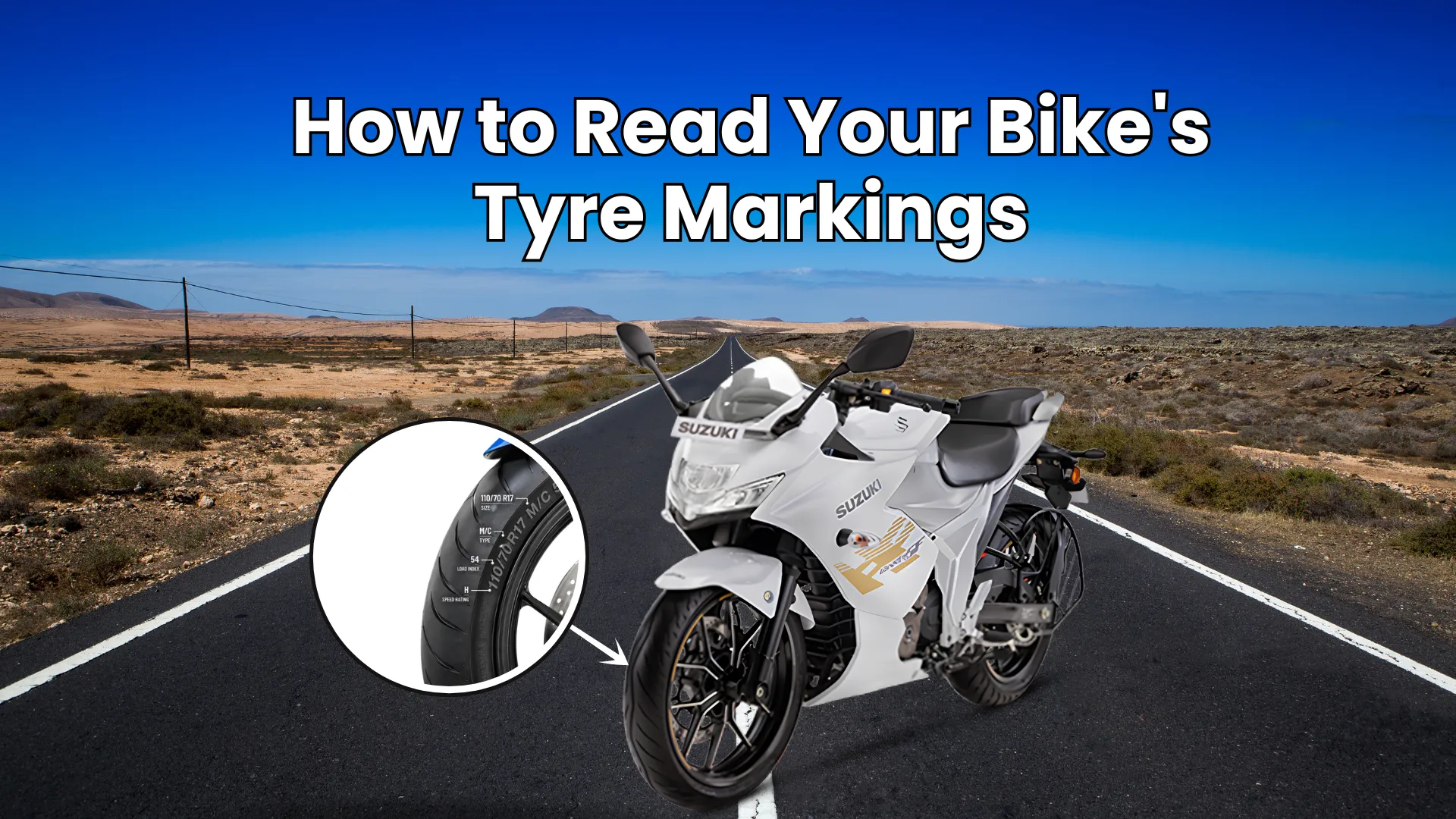
Your tyres are the only connection between your motorcycle and the road. That small patch of rubber carries everything – acceleration, braking, cornering, and stability. That’s why choosing the right tyre isn’t guesswork.
When it’s time to replace your tyres or check if your current ones are correct, understanding the markings on the sidewall becomes essential. In this guide, we break down how to read tyre sizes on bike sidewalls, decode common markings, and understand load and speed ratings so you can choose the right tyre with confidence.
Why Tyre Markings Matter
Every tyre has a series of codes printed on its sidewall that reveal key details like its size, construction type, load capacity, top speed, manufacturing date, aspect ratio (height-to-width), and more. Choosing the wrong tyre can directly affect how your bike performs.
Fit a tyre that’s too wide on a commuter, and you may lose acceleration, fuel efficiency, and handling stability. Install a tyre with a speed rating lower than what your bike is designed for, and you risk a blowout at high speed.
Reading these markings correctly is the easiest way to stay safe on roads and make sure you get the performance you paid for.
The Standard Tyre Marking Format
A typical motorcycle tyre marking looks something like this:
180/55 ZR 17 M/C (73W)
or, in another common variation:
180/50 R17 71W
At first glance, these markings may look confusing. But each part of the sequence conveys specific information about the tyre. Let’s break it down.
Tyre Width
The first number indicates the width of the tyre in millimeters, measured from sidewall to sidewall at its widest point, with the tyre correctly inflated.
In this case 180 = 180 mm width
A wider tyre offers a larger contact patch and more grip, but it also adds weight and rolling resistance. The ideal width is always the one specified by your motorcycle’s manufacturer. Going wider than recommended on a commuter motorcycle can reduce acceleration, reduce fuel efficiency, and compromise handling stability.
On the other hand, going to a narrow tyre size on a performance-oriented motorcycle can compromise grip and confidence, especially while cornering.
Aspect Ratio
The number after the slash (/) is the aspect ratio, also known as the tyre’s profile. The aspect ratio is the height of the sidewall expressed as a percentage of the tyre’s section width.
In 180/55, the 55 means the sidewall height is 55% of the 180 mm width.
A lower aspect ratio means a shorter sidewall, resulting in sharper handling and better cornering ability. A higher aspect ratio gives you a taller sidewall, which absorbs bumps better and improves ride comfort.
- Lower ratio – sportier, better handling
- Higher ratio – more comfort and durability
Sport and performance motorcycles tend to use lower aspect ratios for sharper handling and quicker steering response, while commuters and cruisers usually run higher ratios for added comfort and durability.
Tyre Construction
The letter after the aspect ratio indicates how the tyre is constructed. The most common construction codes you will see are:
| Code | Type | Construction | Speed Capability | Applications |
| D | Diagonal | Nylon cords crisscross | Moderate | For off-road vehicles |
| B | Bias-belted | Diagonal + belts | Medium-high |
Stiffer construction, which allows them to handle heavier loads and perform better on rougher surfaces. Suitable for commuter bikes, cruisers, and motorcycles designed with durability in mind.
|
| R | Radial | 90° plies + steel belts | High |
Stronger sidewalls and are better stability, heat management, and comfort at higher speeds. Flexible sidewalls that absorb road imperfections.
|
| ZR | High-speed radial | Radial + reinforced | Very high (>240 km/h) |
Sports vehicles with very High speed |
| Dash (-) | Breaker | Reinforced tread | Up to ~150 mph | Used on heavier motorcycles, especially, cruisers and touring bikes. Vintage vehicles |
Wheel Diameter
The number after the construction type represents the wheel diameter in inches.
- Example: In 180/55 ZR 17, 17 → fits a 17-inch wheel
This must match your wheel size exactly. A mismatch will make the tyre unusable. A tyre meant for a 17-inch rim cannot be fitted to an 18-inch wheel and vice versa.
The M/C Designation
You may see M/C after the size.
- It simply stands for Motorcycle
- Confirms the tyre is designed specifically for use on motorcycles
Some car and scooter Tyres can look similar in size on paper, so this designation removes any ambiguity.
Load Index
The number that follows the wheel size indicates the load index – a code that represents the maximum weight in kilograms that the tyre can carry.
Here is a portion of the load index table that covers most two-wheelers:
| Load Index | Max Load (kg) | Typical Use |
| 30 | 106 | Small scooters |
| 40 | 140 | Mid-size scooters |
| 47 | 175 | Maxi-scooters |
| 58 | 236 | Entry-level motorcycles |
| 62 | 265 | Mid-size commuter bikes |
| 67 | 307 | Sport bikes |
| 73 | 365 | Heavy touring motorcycles |
| 80 | 450 kg | Large cruisers |
For example: A load index of 73 → The tyre can carry up to 365 kg, and 80 means 450 kg.
This includes the total weight of the motorcycle, rider, pillion, and luggage, so it is worth checking before you load up for a long trip.
Speed Rating
The last letter or letter-and-bracket combination indicates the maximum speed the tyre can safely handle.
Common Speed Ratings:
| Code | Max Speed (km/h) | Max Speed (mph) | Typical Use |
| J | 100 | 62 | Mopeds, scooters |
| L | 120 | 75 | Small motorcycles |
| P | 150 | 93 | Commuter bikes |
| S | 180 | 112 | Standard motorcycles |
| H | 210 | 130 | Sport bikes |
| V | 240 | 149 | High-performance motorcycles |
| W | 270 | 168 | Superbikes |
| Y | 300 | 186 | Racing motorcycles |
Example: W = 270 km/h
The speed rating must match or exceed your bike’s top speed capability.
Older Inch-Based Markings
Many commuter motorcycles in India still use the inch-based format (older format), which looks something like 3.00 – 18 58P. This is read differently from the metric format:
- The first number is the tyre width in inches. Multiply by 25.4 to get millimetres.
- The dash indicates bias-ply construction.
- The next number is the wheel diameter in inches, just like the metric format.
- The load index and speed rating follow the same logic as the metric system.
So in 3.00 – 18 58P
- 3.00 → Width in inches (~76.2 mm)
- Dash (-) → Bias-ply construction
- 18 → Rim size in inches
- 58 → Load index
- P → Speed rating (~150 km/h)
In this system, the aspect ratio is assumed to be 100% by default which means the sidewall height equals the section width.
Date of Manufacture
Every tyre has a date code, usually enclosed in an oval on the sidewall and sometimes preceded by a plant code. The last four digits of this code are what matter:
- First two digits → week
- Last two digits → year
Example:
- 4513 = The tyre was manufactured in Week 45 of the year 2013.
Tyres age even when unused, so always check this before buying.
Other Markings You Should Know
Beyond the main size string, your sidewall may have several other useful markings.
| Marking | Meaning | Explanation |
| TL | Tubeless |
The tyre does not require an inner tube.
|
| TT | Tube-type |
The tyre must be used with an inner tube.
|
| TWI | Tread Wear Indicator |
Small raised bars inside the tread grooves. When the tread reaches this level, the tyre has hit its wear limit and should be replaced.
|
| Direction Arrow | Rotation Direction |
Indicates the correct direction of rotation for proper grip and water dispersal.
|
| NHS | Not for Highway Service |
Found on competition tyres. Not road-legal and intended for track or closed-circuit use only.
|
| Air Pressure | Maximum Inflation |
Shows the maximum recommended tyre pressure (PSI or kPa). Always follow your motorcycle manufacturer’s recommendation instead.
|
| Made in [Country] | Country of Origin |
Indicates where the tyre was manufactured.
|
How to Apply This When Choosing a Tyre for Your Bike
When you buy a replacement tyre, the simplest rule is to follow your motorcycle’s factory specifications.
You can find them in:
- Owner’s manual
- Swing arm sticker
- Existing tyre sidewall
Stick to those numbers and you will keep your bike’s handling and safety characteristics as the manufacturer designed them.
If you plan to change size or type:
- Consult an authorised service centre
- Avoid experimenting with load or speed ratings
Even small changes can impact handling, safety, and warranty.
Final Thoughts
Tyre markings may look like a confusing string of numbers and letters, but once you understand them, they become a powerful tool. With this knowledge, you can confidently choose the right tyre for your motorcycle and avoid costly or unsafe mistakes.
Next time you check your bike, take a moment to read the sidewall, you’ll understand your machine better and make smarter decisions when it’s time for a replacement.
