


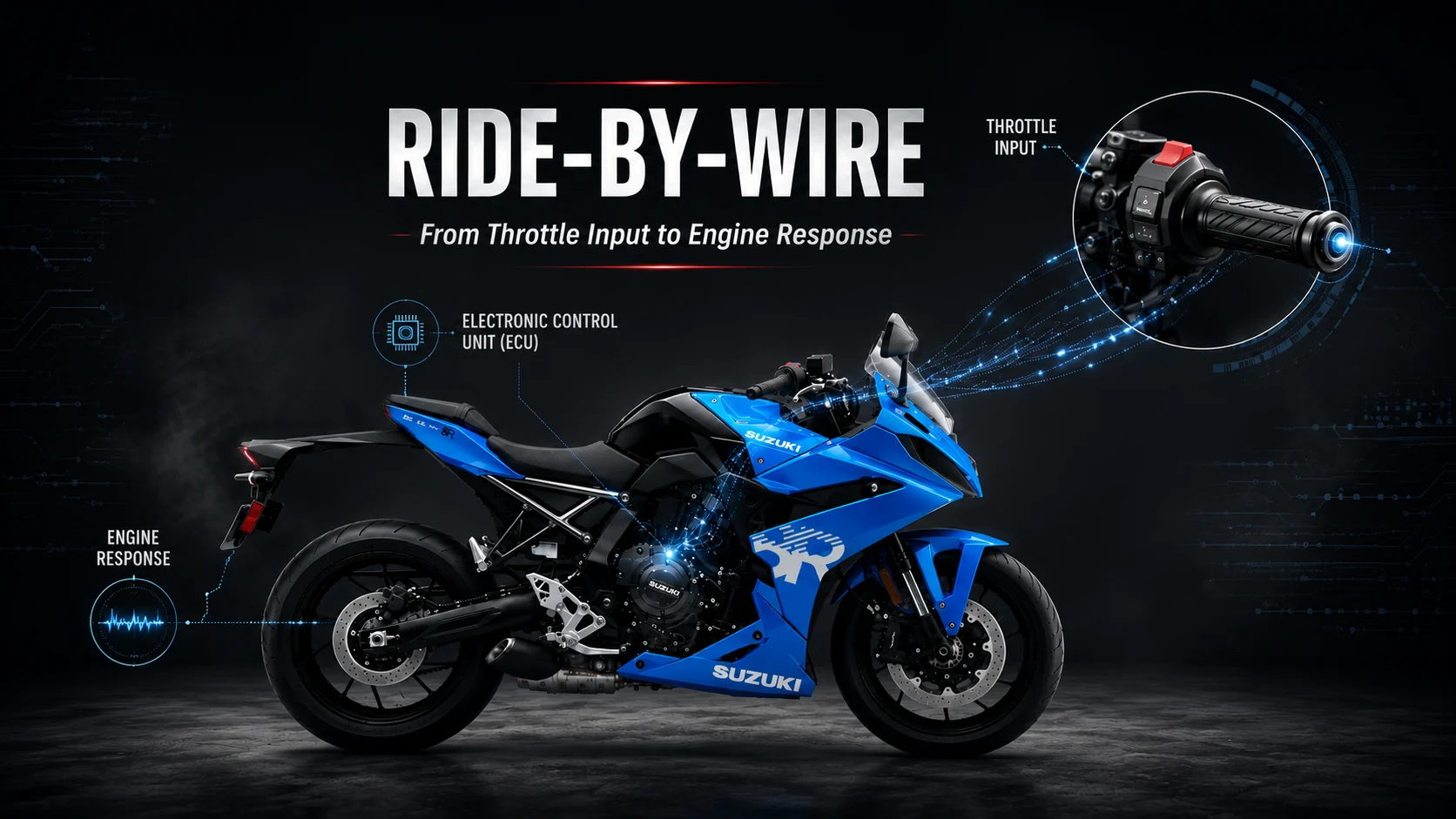
Modern motorcycles increasingly use sophisticated electronic systems to make performance more controllable, adaptable and rider-friendly. One of the technologies that helps make this possible is ride-by-wire.
Unlike a conventional throttle system, where a physical cable directly connects the throttle grip to the throttle mechanism, a ride-by-wire system uses electronic signals to interpret the rider’s throttle input.
This allows the motorcycle’s electronic control system to manage how engine power is delivered and integrate with technologies such as riding modes and traction control.
So, how does ride-by-wire work, and what does it mean for the rider? Here’s a closer look.
What is Ride-By-Wire on a Motorcycle?
Ride-by-wire is an electronic throttle-control system that manages the relationship between the rider’s throttle input and the engine’s response without relying solely on a direct mechanical throttle connection.
With a traditional throttle system, twisting the throttle grip mechanically operates a cable connected to the throttle mechanism.
With ride-by-wire, sensors detect the rider’s throttle-grip input and send that information to the motorcycle’s engine control module (ECM). The ECM then determines the appropriate throttle response based on its programmed calibration.
On Suzuki motorcycles such as the GSX-8R, the Ride-by-wire Electronic Throttle System is cable-free and uses the onboard ECM to finely control the relationship between throttle action and engine output characteristics.
In simple terms:
- Traditional Throttle: Throttle Grip → Mechanical Cable → Throttle Mechanism
- Ride-by-wire: Throttle Grip → Electronic sensors → ECM → Electronic Throttle Actuator → Throttle Valve
The throttle system also uses position feedback so the ECM can monitor the actual throttle-valve position.
The rider still controls the motorcycle. The key difference is that the rider’s throttle input is interpreted and translated into throttle operation electronically.
How Does Ride-By-Wire Work?
The process happens almost instantly whenever the rider turns the throttle.
1. The Rider Twists the Throttle
When the throttle grip is rotated, the rider is requesting a change in engine output.
In a ride-by-wire system, that movement is detected electronically rather than being transmitted directly through a conventional mechanical cable.
2. Sensors Detect Throttle-Grip Position
Electronic sensors monitor the position of the throttle grip and communicate the rider’s input to the motorcycle’s ECM.
3. The ECM Processes the Input
The ECM processes the rider’s throttle input along with relevant operating parameters. It then determines how the engine should respond according to the motorcycle’s calibration.
Based on its calibration, the ECM calculates the appropriate throttle-valve command.
4. The Throttle Valve Is Electronically Controlled
The ECM commands an electronic actuator to control the throttle valve and deliver the required engine response.
5. The System Monitors Throttle Position
Position feedback allows the electronic control system to monitor the actual throttle-valve position and verify that it corresponds with the commanded position.
This means manufacturers can precisely tune the relationship between throttle-grip movement, throttle-valve operation and engine output instead of relying only on a direct mechanical connection.
Ride-By-Wire vs Traditional Throttle
The main difference between the two systems is how the rider’s throttle input is translated into throttle operation.
| Feature | Traditional Throttle | Ride-by-Wire |
| Connection | Mechanical cable | Electronic sensing and control |
| Throttle input | Mechanically transmitted | Electronically detected |
| Throttle operation | Directly linked through a mechanical cable | Electronically controlled by the ECM |
| Throttle-response tuning | Mechanical relationship is largely fixed | Relationship can be electronically calibrated |
| Riding-mode integration | Possible, but more limited | Can support electronically differentiated throttle response |
| Integration with electronic rider aids | More limited | Enables closer integration with electronic engine-management systems |
Ride-by-wire does not mean the rider has less control. It gives manufacturers greater flexibility in controlling how the motorcycle responds to rider input.
What Are the Benefits of Ride-by-Wire?
Ride-by-wire provides several practical advantages on modern motorcycles.
1. More Precise Throttle Control
Because throttle response can be electronically calibrated, manufacturers can more precisely control how the engine reacts when the rider opens the throttle.
This can help provide smoother, more predictable and more precisely controlled power delivery.
On the Suzuki GSX-8R, the Ride-by-wire Electronic Throttle System is designed to provide linear feedback to throttle-grip action, contributing to controllability.
2. Different Riding Modes
Ride-by-wire can support different throttle-response characteristics through selectable riding modes.
For example, one mode can provide sharper response for more immediate acceleration, while another can deliver smoother, more progressive power.
The Suzuki Drive Mode Selector (SDMS) on the GSX-8R offers three modes – Active, Basic and Comfort – with different throttle-response and power-delivery characteristics to suit riding conditions or rider preferences.
This gives riders greater flexibility to adapt the motorcycle’s character to different situations.
3. Integration With Traction Control
Ride-by-wire can also work alongside electronic traction-control systems.
Traction control monitors motorcycle operating conditions to determine whether intervention is required. When necessary, the system can manage engine output to help limit wheel spin.
Suzuki’s GSX-8R combines its Ride-by-wire Electronic Throttle System with the Suzuki Traction Control System (STCS) as part of the Suzuki Intelligent Ride System (S.I.R.S.).
Electronic rider aids support the rider, but they do not replace appropriate throttle control, judgement or riding technique.
4. Better Adaptability to Riding Conditions
The sharpest throttle response is not always the most useful.
In wet conditions, during low-speed manoeuvres or while riding on loose surfaces, smoother power delivery can make a motorcycle easier to manage.
The Suzuki V-STROM 800DE provides a good example. Its Ride-by-wire Electronic Throttle System is tuned to optimise output characteristics to match throttle-grip action, particularly when first opening the throttle. This improves controllability and provides faithful response, especially when riding on gravel roads.
This highlights an important point: ride-by-wire is not simply about faster acceleration. It can also help make power delivery more manageable.
5. Supports Modern Motorcycle Electronics
Ride-by-wire can operate within a wider electronic architecture that includes multiple rider-assistance technologies.
On Suzuki motorcycles equipped with the Suzuki Intelligent Ride System (S.I.R.S.), the electronic package can include technologies such as:
- Suzuki Drive Mode Selector
- Suzuki Traction Control System
- Ride-by-wire Electronic Throttle System
- Bi-directional Quick Shift System
- Low RPM Assist
- Suzuki Easy Start System
Together, these technologies form an integrated electronic package designed to support controllability, convenience and the overall riding experience.
Does Ride-by-Wire Make a Motorcycle Faster?
Not by itself.
Ride-by-wire does not automatically increase an engine’s maximum horsepower or torque. Instead, its main advantage is that it gives engineers greater control over how the available performance is delivered.
A sharper throttle-response setting can make acceleration feel more immediate, while a softer setting can make power delivery more progressive and easier to manage.
So, the key benefit of ride-by-wire is not necessarily more power – it is greater control over how that power is delivered.
How Suzuki Uses Ride-by-Wire Technology?
Suzuki uses ride-by-wire technology across motorcycles designed for different types of riding.
Suzuki GSX-8R
The GSX-8R features Suzuki’s Ride-by-wire Electronic Throttle System as part of its S.I.R.S. package.
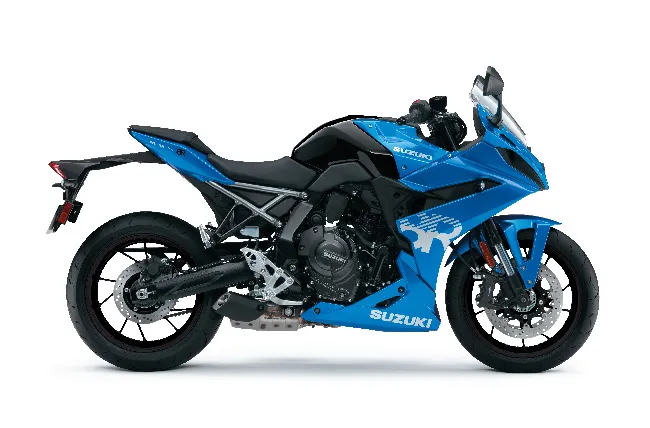
Its cable-free system uses the onboard ECM to finely control the relationship between throttle action and engine output characteristics. The resulting linear feedback to throttle-grip action helps make the GSX-8R feel more controllable.
Suzuki V-STROM 800DE
The V-STROM 800DE also uses a Ride-by-wire Electronic Throttle System.
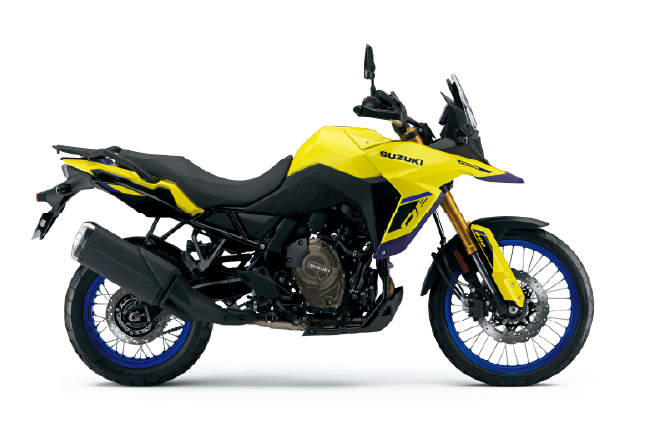
Its individual settings are tuned to optimise output characteristics to match throttle-grip action, particularly when first opening the throttle. This improves controllability and provides faithful response, especially when riding on gravel roads.
Suzuki Hayabusa
The Suzuki Hayabusa also uses a ride-by-wire throttle control system.
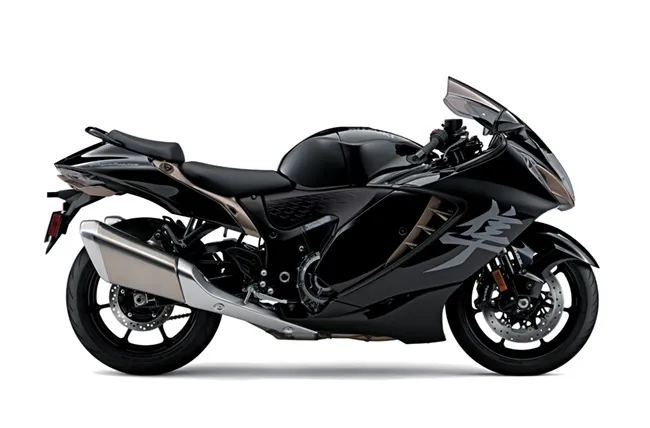
Its ride-by-wire throttle control system provides natural response with linear control.
These examples show how the same underlying technology can be calibrated differently according to the character and purpose of each motorcycle.
Are There Any Disadvantages of Ride-by-Wire?
Ride-by-wire offers significant flexibility, but it also introduces greater electronic complexity.
Compared with a conventional cable-operated throttle, the system relies on sensors, wiring, electronic control, an electronic throttle actuator and software.
Calibration is also important. A well-tuned system can provide smooth and predictable throttle response, while the way the system is calibrated has a significant effect on how the motorcycle feels to the rider.
Because throttle operation is electronically controlled, system monitoring is also an important part of ride-by-wire. Position feedback allows the electronic control system to monitor actual throttle operation, while the exact safety and fault-response strategy varies according to the motorcycle and system design.
Most importantly, ride-by-wire does not replace rider responsibility. The rider remains responsible for throttle input, braking, steering, speed and choosing settings appropriate for the riding conditions.
Final Thoughts
Ride-by-wire is much more than an electronic alternative to a conventional throttle cable.
By electronically managing the relationship between throttle input and engine response, the technology gives engineers greater flexibility to calibrate power delivery, support different riding modes and integrate with modern electronic rider-assistance systems.
On Suzuki motorcycles such as the GSX-8R, V-STROM 800DE and Hayabusa, ride-by-wire is used to deliver throttle characteristics suited to each motorcycle’s intended riding experience.
Ultimately, the biggest advantage of ride-by-wire is not simply more power. It is the ability to make the motorcycle’s available power more controllable, adaptable and predictable.
