


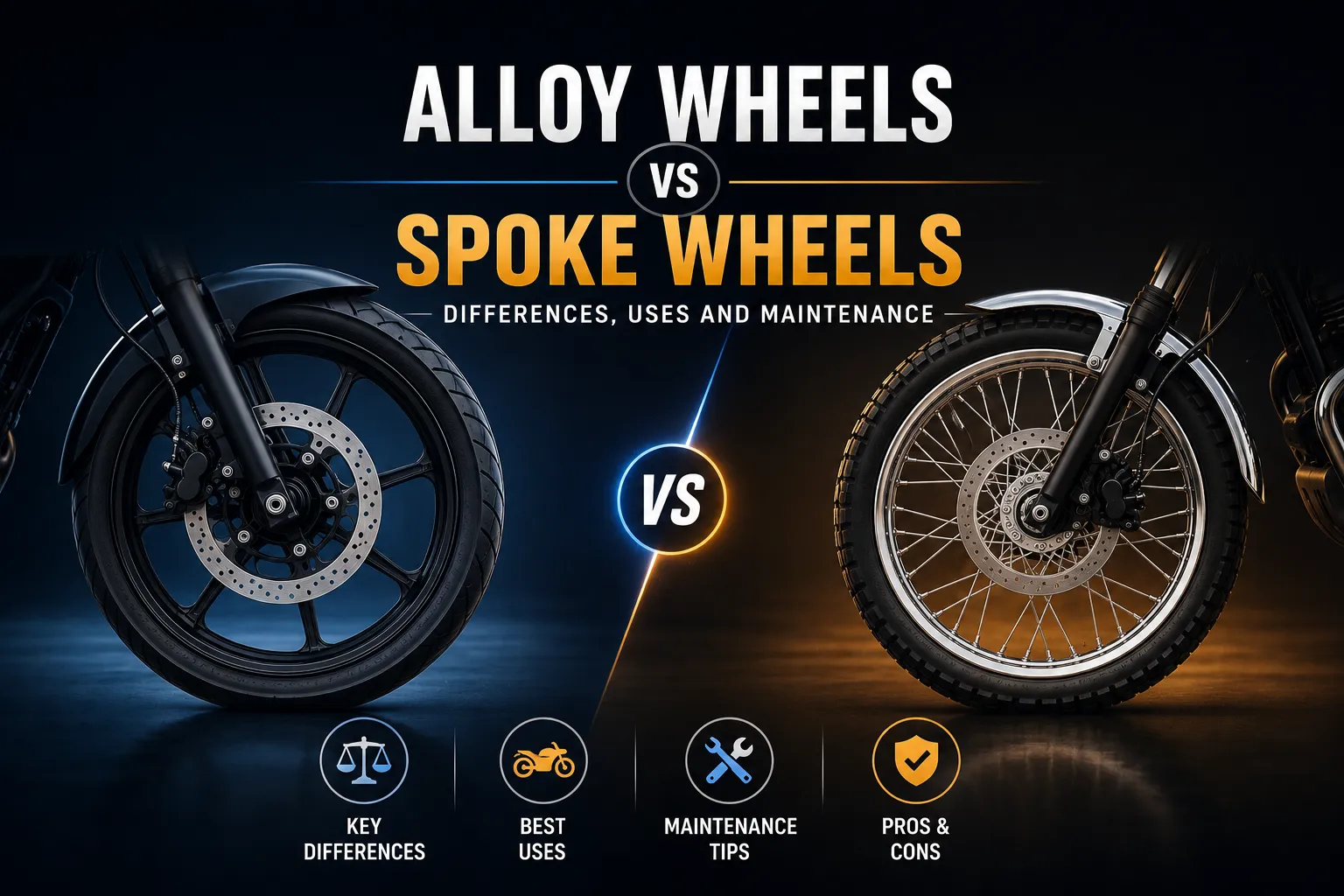
When choosing a motorcycle or scooter, engine performance, mileage, features, comfort and design usually get most of the attention. But wheel construction also plays an important role in how a two-wheeler is engineered for its intended use.
For Indian riders, this can be especially relevant because everyday journeys may include city roads and highways as well as broken tarmac, speed breakers, gravel or occasional unpaved stretches.
Two common wheel constructions used on motorcycles are alloy wheels and wire-spoke wheels. Both support the tyre and transfer forces between the tyre and the motorcycle, but they use different structural designs to do so.
So, what is the main difference between alloy wheels and spoke wheels?
The main difference is in their construction. Alloy wheels generally use a cast or forged structure in which the rim and integral spokes form a more unified wheel assembly. Wire-spoke wheels use a separate rim and hub connected through multiple tensioned spokes.
These construction differences can influence structural behaviour, maintenance, tyre compatibility, serviceability and how the wheel is used within a particular motorcycle design. Neither type is universally better. The appropriate wheel depends on the motorcycle’s intended use, tyres, suspension, chassis and the manufacturer’s engineering specifications.
Quick note: In everyday motorcycle terminology, “alloy wheel” generally refers to a cast or forged wheel with integral spokes, while “spoke wheel” refers to a wire-spoke construction. A wire-spoke wheel can still use an aluminium-alloy rim. In this article, “spoke wheels” refers specifically to wire-spoke wheels.
What Are Alloy Wheels?
Motorcycle alloy wheels are commonly made from aluminium alloys. Many production wheels are cast, while forged alloy wheels are also used in some applications depending on the motorcycle’s design and performance requirements.
Unlike a traditional wire-spoke wheel, the rim, integral spokes and central section are formed as part of a more integrated wheel structure.
This type of construction can be engineered for relatively high stiffness and is widely used on road-oriented motorcycles and scooters. Alloy wheels are commonly designed with rim profiles suitable for tubeless tyres, although the exact tyre and rim configuration depends on the motorcycle.
The weight, strength, stiffness and performance characteristics of an alloy wheel depend on its material, manufacturing process, dimensions and overall design.
Alloy wheels should not automatically be assumed to be lighter than wire-spoke wheels. Actual wheel weight depends on the specific design, dimensions, materials and manufacturing method
What Are Spoke Wheels?
Wire-spoke wheels consist of a rim, hub and multiple tensioned spokes connecting the two.
Rather than using one integrated structure, the individual spokes work together to transfer forces between the rim and hub.
The tensioned-spoke structure can offer a degree of controlled flexibility when the wheel encounters impacts and uneven surfaces. This is one reason wire-spoke wheels are commonly selected for motorcycles designed for adventure riding, trails and varied terrain.
However, the wheel is only one part of the motorcycle’s overall ride and handling package. Tyres, tyre pressure, suspension, chassis design and riding conditions also play important roles.
They are also used on some motorcycles for their classic or distinctive appearance.
Traditional wire-spoke wheels in which the spoke nipples pass through the rim bed often use inner tubes because the rim does not naturally form an airtight chamber. However, specially engineered wire-spoke designs can also support tubeless tyres.
Alloy Wheels vs Spoke Wheels: Key Differences
| Feature | Alloy Wheels | Wire-Spoke Wheels |
| Construction | Integrated wheel structure with integral spokes, commonly cast or forged | Separate rim and hub connected using tensioned wire spokes |
| Structural behaviour | Can be engineered for relatively high stiffness | Can offer a degree of controlled flexibility under impact |
| Tyre compatibility | Tubeless setups are common | May use tube-type or tubeless tyres depending on wheel/rim design |
| Routine maintenance | No spoke-tension checks required | Spoke tension and wheel trueness may require periodic inspection |
| Serviceability | Significant structural damage requires professional assessment and may require wheel replacement | Individual spokes may sometimes be adjusted or replaced, and a serviceable wheel may be professionally trued |
| Typical applications | Common across road motorcycles and scooters | Common on adventure, off-road and some classic motorcycles |
| Cleaning | Integrated design can be relatively straightforward to clean | Multiple spokes may take more time to clean |
| Weight | Depends on material, manufacturing process, dimensions and design | Depends on rim, hub, spokes, dimensions and overall design |
These are general differences rather than fixed rules. Actual characteristics depend on the specific wheel design, materials, motorcycle and intended application.
How Do Alloy and Spoke Wheels Differ in Use?
The difference between the two wheel types become more meaningful when considered as part of the complete motorcycle.
On Paved Roads
Alloy wheels are widely used on motorcycles and scooters designed primarily for paved roads. They can work effectively with road-oriented tyres, suspension and chassis settings to deliver the characteristics intended by the manufacturer.
Wire-spoke wheels can also perform effectively on paved roads when they are part of the motorcycle’s original design.
Therefore, wheel type alone should not be used to determine how suitable a motorcycle is for road riding.
On Rough or Uneven Surfaces
Wire-spoke wheels are commonly selected for motorcycles designed to encounter gravel, trails and uneven terrain.
Their tensioned-spoke construction can provide a degree of controlled flexibility when subjected to impacts and irregular surfaces. Depending on the wheel design and the nature of any damage, individual spokes may also sometimes be adjusted or replaced, and a serviceable wheel may be professionally trued by a qualified technician.
This does not mean alloy wheels are unsuitable for varied riding conditions. Alloy wheels can also be engineered for motorcycles intended to handle mixed surfaces.
The key consideration is whether the wheel, tyre, suspension and chassis have been designed together for the motorcycle’s intended riding environment.
Alloy Wheels, Spoke Wheels and Tubeless Tyres
Tyre compatibility is one of the most practical differences riders consider.
Many alloy motorcycle wheels use rim profiles designed for tubeless operation. When paired with a compatible tubeless tyre and valve, the tyre and rim form an airtight system without a conventional inner tube.
Traditional wire-spoke wheels often have spoke nipples that pass through the rim bed. In these designs, an inner tube is commonly used because the rim does not naturally form an airtight chamber. However, not all spoke wheels require inner tubes.
Some modern wire-spoke designs use alternative spoke arrangements or purpose-designed sealing systems that allow the rim to support tubeless operation.
Important: A tyre marked as tubeless does not automatically make a tube-type rim suitable for tubeless operation. The tyre and rim must be compatible with the configuration specified by the motorcycle manufacturer.
For this reason, riders should check the motorcycle manufacturer’s wheel and tyre specifications rather than assuming tyre type from wheel construction alone.
Maintenance Differences
Both wheel types require regular inspection.
Alloy Wheels: Routine checks should include:
- Inspecting the wheel for visible damage
- Maintaining the recommended tyre pressure
- Checking the tyre condition
- Looking for bends, cracks or signs of impact
- Following the manufacturer’s maintenance schedule
Because alloy wheels do not use individual wire spokes, there are no spoke-tension checks.
Wire-Spoke Wheels: Along with normal tyre and rim inspections, wire-spoke wheels may also require checks for:
- Spoke condition
- Spoke tension
- Wheel trueness and rim run-out
- Rim condition
- Corrosion or physical damage
Any loose or damaged spokes, or a wheel showing abnormal run-out, should be inspected by a qualified technician. Spoke adjustment and wheel truing should be carried out by a qualified technician according to the manufacturer’s specified procedure.
Neither wheel type should be considered maintenance-free..
What Happens If a Wheel Is Damaged?
The correct response depends on the type, location and severity of the damage rather than the wheel category alone.
An alloy wheel is an integrated structural component. Following a significant impact, it should be inspected by a qualified technician. Significant structural damage requires professional assessment and may require wheel replacement, depending on the extent and location of the damage.
A wire-spoke wheel consists of several individual components. Depending on the wheel design, rim and hub condition and the type of damage, individual spokes may sometimes be adjusted or replaced, and a serviceable wheel may be professionally trued.
However, this does not mean every damaged spoke wheel can be repaired, nor does it mean every damaged alloy wheel must be replaced. Any wheel showing signs of structural damage should be professionally inspected before the motorcycle is ridden again.
Which Wheel Type Suits Different Riding Conditions?
Rather than asking which wheel type is better, it is more useful to consider the purpose for which the motorcycle has been engineered.
For motorcycles and scooters designed primarily for everyday paved-road use, manufacturers commonly use alloy wheels as part of the overall road-oriented setup.
For motorcycles expected to encounter more trails, gravel or uneven terrain, manufacturers may select wire-spoke wheels as part of the overall design, alongside tyres, suspension and chassis characteristics suited to those conditions.
For touring and mixed-road motorcycles, either wheel construction may be used depending on the manufacturer’s engineering priorities.
Indian riding conditions can vary widely, from city traffic and highways to broken tarmac, rural roads and occasional unpaved stretches. That is why wheel type should never be judged in isolation. Tyres, suspension, chassis setup and the motorcycle’s intended use matter just as much.
Consider factors such as:
- Intended use of the motorcycle
- Tyre type and size
- Suspension setup
- Typical riding conditions
- Maintenance requirements
- Manufacturer-recommended specifications
How Suzuki Uses Alloy and Wire-Spoke Wheels
Suzuki Motorcycle India’s lineup shows why wheel construction should be considered as part of the complete motorcycle rather than judged in isolation.
Suzuki Avenis
For an urban scooter example, the Suzuki Avenis uses sporty alloy wheels with tubeless tyres, demonstrating a practical alloy-wheel application for everyday urban mobility.
Suzuki GSX-8R
The Suzuki GSX-8R uses lightweight cast aluminium wheels paired with Dunlop RoadSport 2 radial tyres. Suzuki explains that the wheels, tyres and optimised suspension settings work together to support grip, stability, agility and ride comfort.
Suzuki V-STROM SX
The Suzuki V-STROM SX uses lightweight 19-inch front and 17-inch rear 10-spoke cast aluminium wheels. Its semi-block-pattern tyres and chassis package are designed to provide usability on both paved and unpaved roads.
Suzuki V-STROM 800DE
For a more adventure-focused application, the Suzuki V-STROM 800DE uses wire-spoke wheels as part of a chassis package designed for on-road touring, gravel roads and unpaved terrain. The 2025 Indian-market model uses a 21-inch aluminium front rim with wire-spoke wheels and Dunlop TRAILMAX MIXTOUR adventure tyres.
Together, these examples show why wheel type should be viewed as part of the complete vehicle design. Suzuki uses alloy wheels across scooters, road motorcycles and even the mixed-surface V-STROM SX, while the more adventure-focused V-STROM 800DE uses wire-spoke wheels to suit a different engineering objective.
Can You Change from Alloy Wheels to Spoke Wheels or Vice Versa?
Changing wheel type is more than a cosmetic modification.
Wheel dimensions and construction can affect tyre compatibility, axle and bearing fitment, brake-disc mounting, wheel offset, wheel-speed and ABS sensor arrangements, and surrounding clearances. Changes in wheel diameter or tyre profile can also affect chassis geometry and handling.
Riders should therefore use the wheel and tyre configuration recommended by the motorcycle manufacturer. Any replacement or modification should use model-compatible components and remain within the motorcycle manufacturer’s recommended wheel and tyre specifications.
Installation should be carried out by a qualified technician. For a Suzuki motorcycle or scooter, refer to the owner’s manual or consult an authorised Suzuki service centre before changing the original wheel or tyre specification.
Final Thoughts
The comparison between alloy wheels and spoke wheels is best understood as a difference in engineering approach rather than a question of which one is superior.
Alloy wheels generally use a cast or forged structure with integral spokes and are widely found across road-oriented motorcycles and scooters. Wire-spoke wheels use a separate rim, hub and tensioned spokes, a construction that can offer characteristics useful for motorcycles designed for varied or demanding surfaces.
Both can be appropriate when they are part of a motorcycle engineered for the intended riding conditions. When choosing a two-wheeler or replacing a wheel or tyre, always follow the manufacturer’s recommended specifications for that particular model.
