


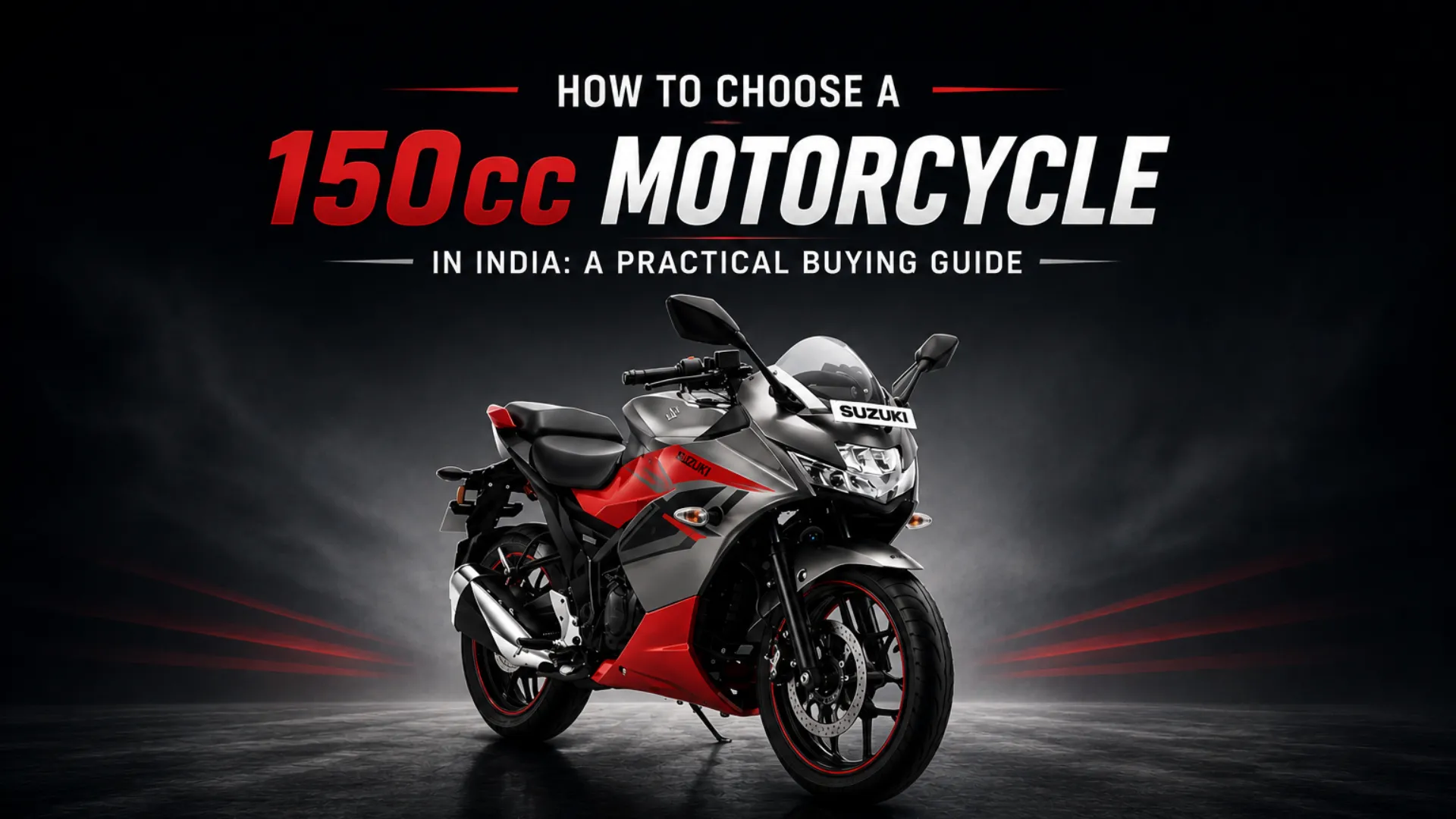
The 150cc motorcycle category occupies a useful space for Indian riders. It offers a step up from smaller commuter motorcycles while remaining practical for everyday riding. But choosing the right motorcycle involves much more than comparing engine capacity or power figures.
Your daily route, riding position, motorcycle weight, braking system, comfort, features, service access and intended usage can all influence which bike is right for you. So, if you are considering a motorcycle in the 150cc class, here are the factors worth evaluating before you make your decision.
Understanding the 150cc Motorcycle Category
The “cc” in a motorcycle’s specification refers to engine displacement, measured in cubic centimetres. However, motorcycles do not need to have an exact 150cc displacement to be considered part of the category. Bikes with slightly higher capacities are commonly grouped into the same segment.
For example, the Suzuki GIXXER and GIXXER SF use a 155cc engine and compete in what is commonly referred to as the 150cc motorcycle class. Engine displacement is therefore a useful starting point, but it should not be the only factor influencing your purchase.
Is a 150cc Motorcycle Good for Daily Use?
For many riders, a 150cc-class motorcycle can make sense for daily riding because this category sits between basic commuter motorcycles and larger-capacity performance machines. But whether a particular motorcycle works well for your commute depends on more than its engine size.
Consider:
- How heavy the motorcycle feels at low speed
- How easily you can reach the ground
- Your riding posture
- Clutch and throttle response
- Turning and manoeuvrability
- Heat and traffic conditions on your route
- Fuel and maintenance requirements
- The availability of authorised service nearby
A motorcycle that feels comfortable during a showroom sit may feel very different after 30 minutes in traffic. A test ride should therefore be part of your buying process, not an optional last step.
What Should You Look for in a 150cc Motorcycle?
Instead of choosing only by engine capacity, compare motorcycles across the following areas.
1. Engine Performance
Start with the basic engine specifications:
- Displacement
- Maximum power
- Maximum torque
- Transmission
- Cooling system
- Fuel injection system
These figures help compare motorcycles, but the highest number does not automatically mean the best motorcycle for your needs. Where an engine produces its torque, how smoothly it responds to throttle inputs and how well its gearing suits city or open-road riding can matter just as much as peak output.
As one current example, the Suzuki GIXXER family uses a 155cc, four-stroke, single-cylinder, air-cooled SOHC engine with fuel injection, producing 13.6 PS at 8,000 rpm and 13.8 Nm at 6,000 rpm, paired with a 5-speed transmission.
The more useful question when comparing engines is not simply “How many cc does it have?” but “Does this engine suit the way I ride?”
2. Riding Position and Comfort
Ergonomics can have a bigger impact on everyday satisfaction than many specification-sheet numbers.
Pay attention to:
- Handlebar position
- Seat height and shape
- Footpeg position
- Knee angle
- Reach to the controls
- Overall riding posture
A more upright riding position may feel natural for riders who spend significant time in traffic, while others may prefer a sportier riding position. There is no universally correct setup. Rider height, reach, flexibility and personal preference all matter.
Seat height alone doesn’t tell the full story
Seat height is useful for comparison, but two motorcycles with the same quoted seat height can still feel quite different. Seat width, motorcycle width, weight distribution and handlebar position can all affect how easily a rider reaches the ground and controls the bike at low speed.
The Suzuki GIXXER and GIXXER SF, for example, both have a 795 mm seat height, despite differences in bodywork, dimensions and weight. That is why sitting on and riding the motorcycle is more useful than judging fit from a single number.
3. Motorcycle Weight
Kerb mass influences how a motorcycle can feel while:
- Moving it out of a parking space
- Making slow U-turns
- Filtering through congested roads
- Stopping and starting repeatedly
- Handling uneven surfaces
A lighter motorcycle is not automatically better. Chassis design and weight distribution also affect how manageable a bike feels. However, kerb mass is still worth comparing, particularly for riders who expect to spend much of their time in city traffic.
Even motorcycles using the same engine can differ here. The Suzuki GIXXER, for example, has a lower quoted kerb mass (141 kg) than the fully faired GIXXER SF (148 kg).
4. Brakes and Anti-Lock Braking System (ABS)
Braking equipment should be a major part of your comparison.
Check:
- Front & rear brake type
- Whether single-channel or dual-channel ABS is fitted
- Brake feel during your test ride
Do not assume that motorcycles in the same engine category offer identical braking systems. The Suzuki GIXXER range uses front and rear disc brakes, while Suzuki identifies the 155cc GIXXER models as being equipped with single-channel ABS.
When comparing other motorcycles, check the manufacturer’s current specification rather than relying on the engine category.
5. Suspension and Tyres
Suspension and tyres influence comfort, stability and handling. When comparing motorcycles, check:
- Front & rear suspension type
- Front and rear tyre dimensions
- Wheel size
- Tyre condition on the actual motorcycle being delivered
Where possible, use your test ride to experience the motorcycle on roads similar to those you normally use. Smooth roads alone will not tell you how the motorcycle behaves over speed breakers, rough patches or uneven surfaces.
6. Ground Clearance
Ground clearance is particularly relevant when your normal routes include:
- Tall speed breakers
- Damaged roads
- Steep parking ramps
- Uneven surfaces
But ground clearance should not be considered in isolation. Wheelbase, suspension movement, load and rider weight can all influence how a motorcycle behaves over obstacles.
7. Fuel Tank Capacity and Real-World Range
Fuel tank size is useful, particularly for riders covering substantial distances, but tank capacity is not the same as riding range.
Actual riding range depends on fuel tank capacity and real-world fuel efficiency.
Fuel consumption can change depending on:
- Traffic
- Riding speed & style
- Throttle use
- Load
- Terrain
- Maintenance
The Suzuki GIXXER and GIXXER SF both have a 12-litre fuel tank. When researching any motorcycle, be careful about relying on a single mileage figure without understanding how it was obtained.
8. Lighting, Instrumentation & Connected Features
Modern motorcycles increasingly combine mechanical specifications with digital convenience features. When evaluating instrumentation, think about what information you will genuinely use rather than simply counting features.
Useful functions may include:
- Digital speedometer
- Fuel-level information
- Trip information
- Warning indicators
- Navigation information
- Smartphone notifications
Lighting is another area worth checking. Look at:
- Head-lamp & tail-lamp type
- Indicator visibility
- Actual nighttime illumination where possible.
The Suzuki GIXXER family includes a digital instrument console with Bluetooth connectivity through Suzuki Ride Connect. The motorcycle also comes with an LED headlamp and LED tail lamp.
Connected features can be convenient, but they should support the riding experience rather than become the main reason for choosing a motorcycle. If Bluetooth connectivity matters to you, try pairing your smartphone before purchase and understand the supported features.
Is a 150cc Motorcycle Good for Highway Riding?
A 150cc motorcycle can be used for highway riding, but highway suitability cannot be determined from engine capacity alone.
Highway usability also depends on:
- Engine performance
- Gearing and stability
- Braking and tyres
- Riding position
- Wind exposure
- Rider and pillion load
- The duration of the journey
An occasional weekend highway ride and a daily long-distance highway commute place very different demands on a motorcycle. Therefore, instead of asking only: “Can a 150cc bike go on the highway?”, ask: “Is this particular motorcycle comfortable and capable enough for the type of highway riding I intend to do?” That gives a much more useful buying decision.
Naked or Fully Faired: Choosing a Body Style
This is another area where there is no universal winner. A naked motorcycle typically uses minimal bodywork and exposes more of the engine and chassis.
A fully faired motorcycle uses additional bodywork around the front and sides, giving the motorcycle a different visual character and altering the amount of direct airflow reaching the rider.
Your decision can therefore depend on:
- Styling preference
- Riding posture
- Riding environment
- Weight, dimensions and intended use
Within Suzuki’s 155cc range, the GIXXER represents the naked street-bike format, while the GIXXER SF uses a full fairing and sportier riding position.
Making the Most of a Test Ride
A good test ride is not about finding out how quickly the motorcycle accelerates. Use it to assess how the motorcycle fits into your everyday life.
At a standstill, check:
- Can both feet reach the ground comfortably enough for you?
- Does the bike feel difficult to move backwards?
- Is the handlebar reach natural?
- Are the mirrors useful?
- Can you operate the switches easily?
At low speed, check:
- Clutch control
- Throttle smoothness
- Turning behaviour
- Balance
- Brake modulation
- U-turn confidence
At normal road speed, check:
- Engine response
- Braking & gear changes
- Ride comfort & posture
- Visibility
- Vibration
If you expect to ride with a pillion regularly, evaluate pillion accommodation as well.
How to Choose the Right 150cc Motorcycle: A Simple Checklist
Before making a decision, ask yourself:
1. Where will I ride most?
Primarily city roads, mixed use or frequent highway journeys.
2. Does the motorcycle physically fit me?
Check seat height, ground reach, handlebar position and overall ergonomics.
3. Am I comfortable with its weight?
Test this at parking and U-turn speeds, not just while moving.
4. Does the engine suit my riding style?
Consider response and gearing, not just the cc figure.
5. What braking equipment does it have?
Check the current ABS and brake specification.
6. Will I regularly carry a pillion?
Evaluate the rear seat and footpeg position.
7. Are the features useful to me?
Do not pay attention to a long feature list if you will not use those features.
8. Is the motorcycle compatible with current fuel requirements?
Check the manufacturer’s specification.
9. Is authorised service convenient?
Ownership continues long after the showroom visit.
10. Have I taken a proper test ride?
The specification sheet should narrow your shortlist. The test ride should help make the final decision.
Where Does the Suzuki GIXXER Fit in the 150cc Category?
For riders considering a Suzuki within this engine category, the GIXXER and GIXXER SF use a 155cc, air-cooled, single-cylinder, fuel-injected engine producing 13.6 PS and 13.8 Nm and are paired with a 5-speed manual transmission.
The current range also includes features such as:
- Anti-Lock Braking System (ABS)
- Front and rear disc brakes
- LED headlamp and tail lamp
- Bluetooth-enabled digital console
- E20 compatibility
- Split-seat design
- Side-stand interlock
The GIXXER uses naked street-bike styling, while the GIXXER SF uses full fairing and a clip-on handlebar for a sportier riding position. Suzuki already covers the model-to-model decision in its dedicated Gixxer VS Gixxer SF comparison guide.
Final Takeaway: What Makes a Good 150cc Motorcycle?
The best 150cc motorcycle for you is not automatically the one with the highest power figure, the longest feature list or the most aggressive styling.
It is the motorcycle that best fits your:
- Daily route
- Riding experience
- Body and ergonomics
- Performance needs
- Expected pillion use
- Ownership requirements
- Personal preferences.
Use specifications to create a shortlist. Use the test ride to make the decision. And before buying, verify the current model specifications, price, equipment and warranty with the manufacturer or authorised dealer, because these can change over time.
