


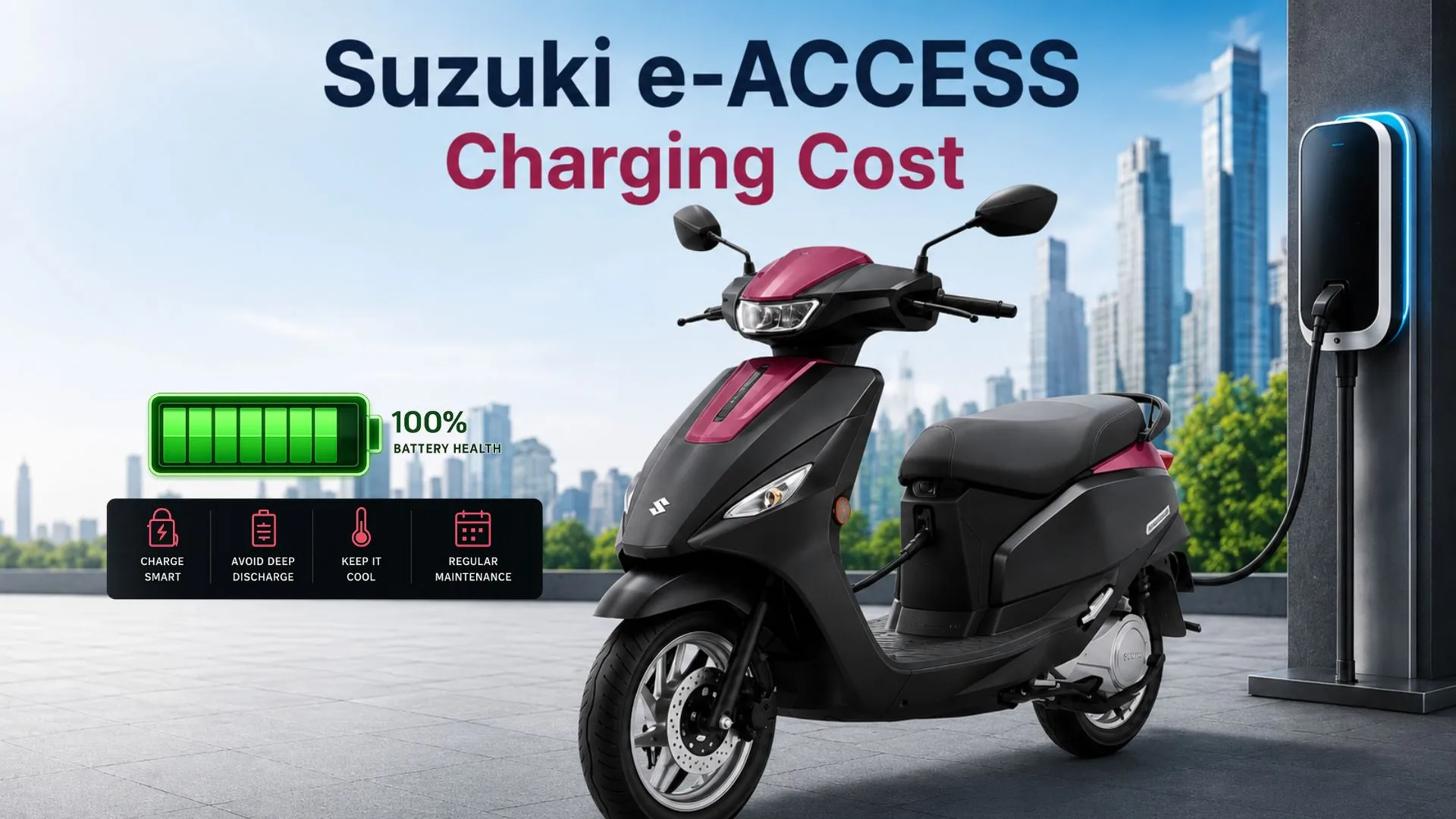
When considering an electric scooter, most buyers are not asking about horsepower or advanced technology first. Instead, they want answers to three simple questions: How long does it take to charge? What does a full charge cost? And how far can it travel on a single charge?
The answers to these questions play a major role in determining the overall ownership experience. Understanding the electric scooter charging cost is particularly important, as it directly affects day-to-day running expenses and long-term savings.
In this guide, we’ll break down the Suzuki e-ACCESS charging time, calculate the e-ACCESS charging cost at different electricity tariffs, estimate the e-ACCESS cost per km, and examine what riders can expect in terms of range and overall ownership costs.
Suzuki e-ACCESS Battery, Range and Charging Specifications
To understand the Suzuki e-ACCESS charging cost and cost per kilometre accurately, it is important to start with the scooter’s battery, range and energy-consumption specifications.
Battery Specifications
- Battery Capacity: 3.072 kWh
- Battery Type: Lithium Iron Phosphate (LFP) chemistry
- Battery Rating: 51.2V, 60Ah
- Battery Configuration: Fixed battery pack (not swappable)
- Certified Range: 95 km (AIS-040 standard)
- Energy consumption: 39 Wh/km (AIS-039 standard)
LFP battery chemistry is widely recognised for its high durability, thermal stability and long years of life, making it particularly suitable for everyday urban mobility.
Charging Time
The Suzuki e-ACCESS supports both regular home charging and fast charging, giving riders the flexibility to choose a charging method that suits their riding needs.
- Portable Home Charger: The Suzuki e-ACCESS comes with a portable charger that connects to a standard household power socket (single-phase AC 200–240V, 50/60Hz). This makes home charging convenient for everyday use without requiring specialised charging equipment.
| Charge Level | Charging Time |
| 0 to 80% | 4 hours 30 minutes |
| 0 to 100% | 6 hours 20 minutes |
For most riders, overnight charging is the most practical solution. Plugging the scooter in before bedtime can provide a full charge by morning, making daily charging convenient and hassle-free.
- Fast Charging: For riders who need quick charging, the Suzuki e-ACCESS supports fast charging at designated charging units across the SMIPL authorized dealer network.
| Charge Level | Charging Time |
| 0 to 80% | 1 hour 12 minutes |
| 0 to 100% | 2 hours 12 minutes |
(Fast Charger specification: Off-board type, single-phase AC 200–240V, 50/60Hz).
While overnight home charging is likely to meet the needs of most daily commuters, fast charging provides added convenience for longer rides and quick top-ups during the day. Riders planning extended journeys should check the availability of compatible fast-charging facilities along their route before travelling.
Note: Charging times are reference figures measured under standard testing conditions at an ambient temperature of approximately 25°C. Actual charging duration may vary depending on battery temperature, ambient conditions, charger performance and power-supply quality.
Suzuki e-ACCESS Range: Understanding Certified and Real-World Performance
The Suzuki e-ACCESS has a certified range of 95 km under the AIS-040 standard, India’s official testing protocol for electric two-wheelers. As with all EVs, actual riding range can vary depending on usage and riding conditions.
Factors That Affect Range
- Riding Mode: Eco Mode prioritises efficiency, while Ride A and Ride B offer higher performance.
- Rider and Payload: Carrying a pillion or extra luggage can increase energy consumption.
- Traffic Conditions: Frequent braking and acceleration in city traffic can impact range.
- Terrain: Hills and steep gradients require more energy than flat roads.
- Weather: Extreme temperatures can affect battery efficiency.
- Tyre Pressure: Maintaining the recommended tyre pressure helps maximise efficiency.
Maximising Range
Using Eco Mode, riding smoothly, maintaining proper tyre pressure and avoiding unnecessary acceleration can help achieve the best possible range from every charge.
Note: The certified 95 km range is measured under AIS-040 test conditions. Actual range may vary based on riding style, traffic, terrain, weather and vehicle load.
Electric Scooter Charging Cost: Suzuki e-ACCESS Explained
One of the biggest advantages of owning an EV is its low charging expense.
Formula: Battery Capacity (kWh) × Electricity Rate (₹/kWh) = Full Charge Cost
With a battery capacity of 3.072 kWh, here is what a full 0–100% charge of the e-ACCESS costs at different residential tariffs commonly seen across Indian cities.
| Electricity Tariff | Cost of Full Charge |
| ₹ 5/kWh | ₹ 15.36 |
| ₹ 6/kWh | ₹ 18.43 |
| ₹ 7/kWh | ₹ 21.50 |
| ₹ 8/kWh | ₹ 24.58 |
| ₹ 9/kWh | ₹ 27.65 |
| ₹10/kWh | ₹ 30.72 |
At residential electricity rates commonly seen across Indian cities, a full charge generally costs between ₹21 and ₹31.
Accounting for Charging Losses: Charging systems are not 100% efficient. A small amount of energy is lost through:
- Heat generation
- Power conversion
- Battery management systems
- Grid fluctuations
As a result, real-world charging losses can increase electricity consumption by approximately 5–15%. In practical terms, riders can add roughly ₹2–₹4 per charge to estimate actual home charging expense. Typical real-world charging cost: ₹24–₹34 per full charge
Suzuki e-ACCESS Cost Per Kilometer
The next important metric is the e-ACCESS cost per km.
Formula: Energy Consumption (kWh/km) × Electricity Tariff (₹/kWh) = Cost per Kilometre
At 39 Wh/km, or 0.039 kWh/km, Cost per Kilometer works out as follows:
| Electricity Tariff | Cost of Full Charge |
| ₹ 5/kWh | ₹ 0.20 (20 paise/km) |
| ₹ 6/kWh | ₹ 0.23 (23 paise/km) |
| ₹ 7/kWh | ₹ 0.27 (27 paise/km) |
| ₹ 8/kWh | ₹ 0.31 (31 paise/km) |
| ₹ 9/kWh | ₹ 0.35 (35 paise/km) |
| ₹10/kWh | ₹ 0.39 (39 paise/km) |
After accounting for charging losses, most riders can realistically expect a running cost of approximately ₹0.30–₹0.35 per kilometre. This is where the true advantage of electric mobility becomes obvious.
Note: Electricity tariffs in India vary by state and by consumption slab. Always check your latest electricity bill to determine your applicable tariff.
Monthly Running Cost of the Suzuki e-ACCESS
The monthly charging expense of the Suzuki e-ACCESS depends primarily on daily riding distance, electricity tariffs, and charging efficiency.
Let’s assume a typical urban commute of 30 km per day and an electricity tariff of ₹8 per kWh; here’s how the cost works out.
| Step | Formula | Result |
| Daily distance travelled | – | 30 Km |
| Energy consumption | – | 39 Wh/km (0.039 kWh/km) |
| Daily energy consumed | 30 × 0.039 | 1.17 kWh |
| Daily cost at ₹8/kWh | 1.17 × ₹8 | ₹9.36 |
| Monthly cost at ₹8/kWh (30 days) | ₹9.36 × 30 | ₹281 |
After accounting for typical charging losses of 5–15%, the charging cost will work out to be approximately ₹295–₹323 per month.
Note: Monthly charging costs are illustrative estimates based on 30 km of daily riding, an electricity tariff of ₹8 per kWh and typical charging losses. Actual costs may vary depending on riding distance, local electricity rates and charging conditions.
Battery Life and Long-Term Ownership Costs
The e-ACCESS uses a Lithium Iron Phosphate (LFP) battery, a chemistry known for its durability, thermal stability and long cycle life (4 times more than NMC). Compared with Nickel Manganese Cobalt (NMC) batteries, LFP technology is designed to maintain performance over a greater number of charge cycles, helping support consistent efficiency throughout the ownership period.
The scooter also features a maintenance-free belt-drive system that does not require regular lubrication and has an expected service life of approximately 70,000 km or seven years, helping reduce maintenance requirements over time.
How It Impacts Running Costs
Long-term battery health plays an important role in the overall electric scooter running cost. As batteries age, reduced capacity can affect range and efficiency, potentially increasing the effective cost per kilometre. The long cycle life characteristics of LFP chemistry help minimise capacity degradation, supporting more consistent range and charging efficiency over years of use.
Combined with low charging costs and reduced maintenance needs, these features help keep the Suzuki e-ACCESS charging cost and overall ownership expenses predictable over the long term.
Closing Note
The Suzuki e-ACCESS combines low charging costs, practical charging times, and efficient energy consumption to deliver an economical ownership experience. At typical Indian electricity tariffs ranging between ₹7–₹10 per kWh, a full charge costs approximately ₹21–₹31, while the running cost works out to roughly ₹0.30–₹0.35 per kilometre.
For most riders, overnight charging using the supplied portable charger is sufficient for daily commuting, while fast-charging facilities across the Suzuki dealer network offer added convenience when quicker top-ups are required.
To explore the Suzuki e-ACCESS in person or book a test ride, visit your nearest authorised Suzuki Motorcycle India dealership or learn more on the official Suzuki e-ACCESS product page.
Disclaimer: Charging times and range figures are reference values obtained under standard test conditions. Actual charging duration, range and running costs may vary depending on riding style, traffic conditions, vehicle load, weather, charging efficiency and local electricity tariffs.
