


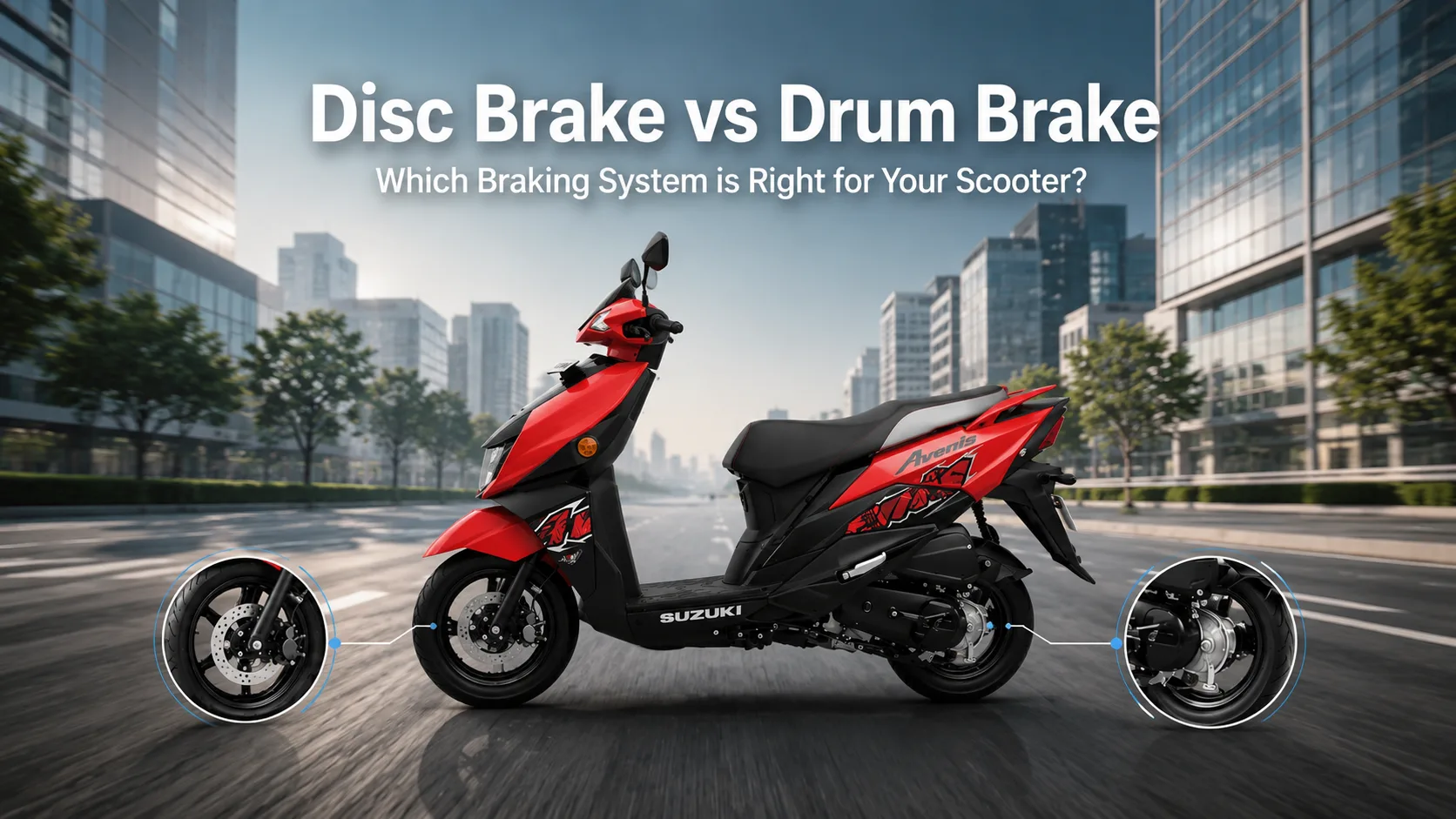
Brakes are among the most important safety features on any scooter. While buyers often compare mileage, design, and features before making a purchase, the braking system is equally important because it directly influences how a scooter responds in everyday riding situations.
One of the most common questions scooter buyers ask is: Should I choose a scooter with disc brakes or drum brakes?
Both braking systems are widely used across modern scooters and are designed to provide reliable stopping performance. However, they differ in how they operate, how they respond in different riding conditions, and what type of riding experience they offer.
This guide explains the difference between disc brakes and drum brakes on scooters, how each system works, the role of CBS and ABS, and the braking configurations available across Suzuki’s scooter range.
What is a Drum Brake?
A drum brake is a braking system that operates inside a closed metal drum attached to the wheel.
Inside the drum are brake shoes lined with friction material. When the brake lever is applied, the brake shoes press against the inner surface of the rotating drum. The resulting friction slows the wheel and helps bring the scooter to a stop.
The enclosed design helps protect the internal braking components and reduce direct exposure to dust, mud, and road debris.
Common Applications of Drum Brakes on Scooters
Drum brakes are commonly found on:
- Rear wheels of many scooters
- Entry-level scooter variants
- Scooters designed for everyday urban commuting
Drum brakes have been used successfully for decades and continue to be a practical and cost-effective braking solution for everyday urban and suburban commuting.
What is a Disc Brake?
A disc brake uses a flat metal rotor, commonly called a disc, mounted to the wheel, and a caliper fitted with brake pads. On most modern scooters, applying the brake lever creates hydraulic pressure that pushes the brake pads against the rotating disc. The resulting friction reduces wheel speed and helps bring the scooter to a stop.”
Unlike a drum brake, the braking surface is exposed to open air. This design allows heat to dissipate more efficiently and makes visual inspection of brake components easier.
Common Applications of Disc Brakes on Scooters
Disc brakes are often found on:
- Front wheels of premium and mid-spec scooter variants
- Higher-specification scooter models
- Scooters intended for frequent city commuting and mixed riding conditions
Many modern scooters use a combination of a front disc brake and a rear drum brake.
Disc Brake vs Drum Brake on Scooters: Key Differences
Both braking systems serve the same purpose, but they operate differently. Understanding these differences can help buyers choose a braking setup that aligns with their riding requirements.
1. Braking Response
On most modern scooters, a disc brake is hydraulically operated. Its rotor-and-caliper design generally provides a progressive braking response and consistent brake feel.
Drum brakes use brake shoes that expand against the inner surface of a drum to create braking force. Due to their design and operating mechanism, their braking feel and consistency may differ from those of disc brakes.
Actual braking performance depends not only on the type of brake system but also on factors such as tyre grip, road conditions, vehicle load, brake-system tuning, component condition, and rider input.
2. Performance in Wet Conditions
Both disc and drum brakes are designed to operate in wet weather.
An exposed disc brake may initially become wet, but wheel rotation and contact between the brake pads and the disc generally help clear water from the braking surface quickly. Drum brakes are better shielded from direct water splashes. However, if moisture enters the drum assembly, it may take longer to disperse because the braking components are enclosed.
Proper maintenance remains important for ensuring consistent braking performance in all weather conditions.
3. Heat Management
Braking generates heat, particularly in dense traffic or during repeated stops. Because disc brakes are exposed to airflow, they dissipate heat more efficiently during repeated use. Drum brakes retain more heat because the braking components are enclosed within the drum assembly.
4. Maintenance and Serviceability
Both braking systems require periodic inspection and maintenance.
Drum Brakes
- Brake components are protected from external contaminants.
- Brake shoes require inspection for wear during scheduled servicing.
- Accessing internal components typically requires the drum assembly to be opened.
Disc Brakes
- Brake pads, caliper, and rotors are externally mounted, allowing for easier inspection.
- Brake pad wear can often be checked visually.
- Routine servicing typically involves inspecting pads, rotors, and hydraulic components.
Neither brake system is maintenance-free, and regular servicing remains important for consistent braking performance.
5. Cost Considerations
Braking systems can influence the price of a scooter variant.
Drum brakes are commonly found on value-oriented models, while disc brakes are often included on higher-specification variants that may also feature additional equipment. When comparing variants, it is helpful to consider the overall package, including safety features, connectivity options, instrumentation, and comfort features, rather than evaluating the brake type alone.
Why Do Many Scooters Use a Front Disc and Rear Drum Combination?
Many scooters use a front disc brake and rear drum brake combination because load shifts toward the front wheel, particularly under hard braking. As a result, the front wheel typically handles a larger share of the braking load, while the rear wheel contributes to stability and balance.
This combination allows manufacturers to balance braking performance, durability, maintenance requirements, and overall cost.
It is one of the most common brake configurations found on modern scooters.
What is Combined Braking System (CBS)?
CBS is a linked braking arrangement designed to apply braking force to both the front and rear wheels in a predetermined proportion. CBS supports more balanced and predictable braking during everyday riding.
CBS is commonly found on modern scooters and can be used with both disc and drum brake configurations.
What is Anti-Lock Braking System (ABS)?
Unlike CBS, ABS uses wheel-speed sensors and an electronic control unit to monitor wheel speed during braking. If the system detects that a wheel is close to locking up during hard braking, it automatically adjusts hydraulic brake pressure.
This helps reduce the likelihood of wheel lock-up and allows the rider to maintain greater steering control during hard braking.
ABS can be particularly beneficial in emergency braking situations or when road grip changes unexpectedly. However, it does not guarantee a shorter stopping distance under all road conditions.
CBS vs ABS: Understanding the Difference
Although both systems are designed to support safer braking, they work in different ways.
| Feature | CBS | ABS |
| Full Form | Combined Brake System | Anti-Lock Braking System |
| Function | Distributes braking force between wheels in a predetermined proportion. | Helps prevent wheel lock-up |
| Primary Purpose | Improved braking balance | Improved control and stability during hard braking |
| Common Availability | Many scooter variants | Select higher-specification variants |
CBS and ABS perform different braking-assistance functions and may be offered separately or in combination, depending on the vehicle design.
Suzuki Scooters Brake Configurations in India
Suzuki offers different braking configurations across its 125cc scooter range.
| Model / Variant | Front Brake | Rear Brake |
| Access Standard Edition | Drum | Drum |
| Access Special Edition | Disc | Drum |
| Access Ride Connect Edition | Disc | Drum |
| Access Ride Connect TFT Edition | Disc | Drum |
| Access Ride Connect ABS Edition | Disc | Drum |
| Access Ride Connect TFT ABS Edition | Disc | Drum |
| Avenis (All Variants) | Disc | Drum |
| Burgman Street | Disc | Drum |
| Burgman Street EX | Disc | Drum |
| e-Access | Disc | Drum |
The pattern across the range is clear. Most Suzuki scooter variants in India feature a front disc brake and rear drum brake combination, while the Access Standard Edition uses drum brakes at both ends.
Choosing Between Disc Brakes and Drum Brakes
The choice between a disc brake and a drum brake depends on several factors, including the scooter variant, riding environment, preferred features, and budget.
When comparing scooter variants, buyers may consider:
Riding Conditions
Riders who frequently encounter stop-and-go traffic, changing weather conditions, or routes that involve repeated braking may prefer to compare variants equipped with a front disc brake because of its heat dissipation and consistent braking response.
For everyday commuting and routine urban travel, drum brake-equipped variants continue to be widely used across the scooter segment.
Maintenance Preferences
Disc brake components are generally easier to inspect because the brake pads and rotor are externally mounted. Drum brake components are housed within the drum assembly and are inspected as part of scheduled servicing.
Budget and Variant Choice
Drum brakes are commonly found on entry-level and value-oriented scooter variants, while disc brakes are frequently offered on higher-specification variants that may include additional equipment and features.
As a result, the decision often involves evaluating the overall value offered by a particular variant rather than comparing the braking system in isolation.
Final Consideration
Both drum brakes and disc brakes continue to be widely used across modern scooters. The most suitable option depends on the features offered by a particular variant, intended usage, maintenance preferences, and budget.
Closing Note
Disc brakes and drum brakes both continue to play an important role in modern scooter design. Disc brakes are often appreciated for their accessible visual inspection, better heat management, and more consistent braking response during repeated use. Drum brakes remain durable, cost-effective, and suitable for everyday commuting when correctly maintained.
When comparing scooter variants, buyers should evaluate the overall package including braking technology, CBS or ABS availability, features, intended usage, and budget rather than focusing on a single specification. Suzuki’s scooter range offers multiple braking configurations, giving buyers the flexibility to choose a setup that aligns with their needs and riding preferences.
For the most practical comparison, a test ride can often provide the clearest understanding of how different braking systems feel in real-world conditions. Book a test ride on the Suzuki Motorcycle India website or visit your nearest authorised Suzuki Motorcycle India dealership.
