


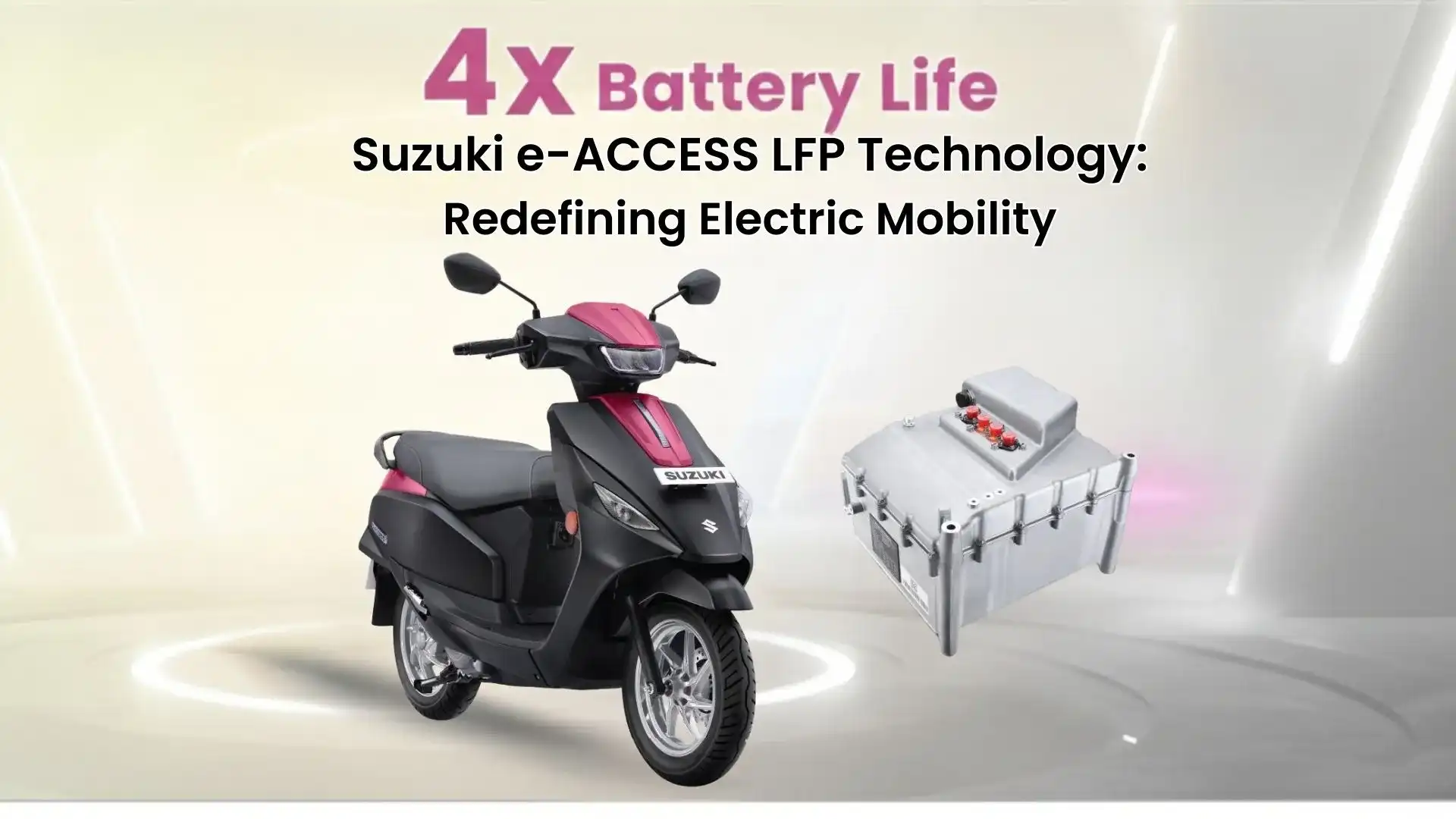
The transition to electric mobility has gained significant momentum in India, with more riders recognizing the benefits of cleaner, quieter transportation. However, as the electric two-wheeler market matures, one critical question continues to influence purchase decisions: how long will the battery last?
This concern isn’t just about the daily range, it’s about the battery’s ability to maintain performance over years of use. This is where the Suzuki e-ACCESS, powered by Suzuki e-Technology, introduces a fundamental advantage through its choice of Lithium Iron Phosphate (LFP) battery technology.
Understanding the 4X Battery Life Advantage
When Suzuki states that LFP batteries deliver four times the cycle life of conventional NMC (Nickel Manganese Cobalt) batteries, this represents a transformative shift in electric vehicle ownership economics. But what does this mean in practical terms for daily riders?
Battery cycle life refers to the number of complete charge-discharge cycles a battery can undergo before its capacity degrades to a specified threshold. While conventional NMC batteries, commonly used in many electric two-wheelers, typically offer a certain baseline of charge cycles, LFP technology extends this significantly, specifically, by a factor of four, according to Suzuki’s engineering assessments.
This isn’t merely a technical specification, it translates directly into years of consistent performance. For a rider who charges their vehicle daily, this extended cycle life means the battery maintains its capacity and performance characteristics far longer than conventional alternatives, ensuring that the riding experience remains predictable and reliable throughout the vehicle’s operational lifespan.
Why Suzuki Chose LFP Technology
The decision to equip the e-ACCESS with LFP batteries wasn’t arbitrary. Suzuki specifically selected this chemistry because it delivers what the company describes as “the better balance of capacity, durability, high reliability in the event of damage, and long cycle life.” This selection reflects Suzuki’s engineering philosophy of prioritising long-term value over short-term performance gains.
LFP chemistry offers distinct advantages that align with real-world riding conditions in India. The thermal stability of LFP batteries is particularly relevant in a climate where temperatures can soar, and vehicles often operate in demanding stop-start traffic conditions. This stability means the battery maintains consistent performance even when subjected to heat stress, a critical factor for daily reliability.
Moreover, by extending the life of what Suzuki acknowledges as “the most expensive component in an electric vehicle,” the e-ACCESS maximizes the inherent advantages of electric mobility: low maintenance costs and reduced running expenses. This approach ensures that the economic benefits of electric vehicle ownership compound over time rather than diminish.
Real-World Usability: What Users Experience
For daily riders, the practical benefits of extended battery life manifest in several meaningful ways. First, there’s the assurance of a consistent daily range. As conventional batteries age and their capacity degrades, riders often find their usable range shrinking, what once provided 80 kilometres might drop to 60 or less after a few years of use.
With LFP technology, this degradation occurs at a significantly slower rate, meaning riders can rely on consistent performance year after year. This consistency eliminates the anxiety that often accompanies electric vehicle ownership. Riders don’t need to constantly adjust their routines or worry about whether their vehicle will still meet their needs in two or three years.
The range they experience in year one remains substantially similar in subsequent years, providing the predictability that’s essential for daily transportation. Additionally, the thermal stability of LFP batteries ensures that performance remains steady across India’s varying climate conditions.
Whether riding through summer heat or monsoon humidity, the battery’s chemistry is engineered to maintain stable operation, reducing concerns about seasonal performance variations.
Engineering Excellence Through Rigorous Testing
Suzuki’s commitment to battery reliability extends beyond chemistry selection to comprehensive validation. The company states that development testing on the e-ACCESS follows “the same rigorous test as large motorcycles like Hayabusa“, a testament to the stringent quality standards applied to this electric vehicle.
The testing regime includes battery submersion tests to ensure water resistance, crush tests to verify structural protection, puncture tests to validate safety protocols, and temperature tests to confirm performance across extreme thermal conditions. This comprehensive approach reflects what Suzuki describes as “truly reliable craftsmanship” that comes from “meticulous attention to details and the legacy built over time.”
Furthermore, the e-ACCESS features a secure battery box integrated into the frame structure, providing enhanced physical protection for the battery pack. This structural integration isn’t merely about mounting, it’s designed to safeguard the battery from the impacts, vibrations, and environmental stresses encountered in daily riding, contributing to the battery’s long-term durability.
The Cost-Effectiveness of Longevity
While the technical advantages of LFP technology are significant, the financial implications deserve equal attention. By extending battery life by a factor of four, the e-ACCESS fundamentally alters the total cost of ownership equation for electric two-wheelers.
Battery replacement represents one of the most significant potential expenses in electric vehicle ownership. By substantially extending the operational lifespan of the battery, Suzuki reduces or potentially eliminates this recurring cost for most owners throughout the vehicle’s primary use period. This means the savings from electric operation, already substantial compared to conventional fuel costs, aren’t offset by expensive battery replacements after a few years.
Moreover, this extended lifespan contributes to higher residual values. A vehicle whose battery maintains strong performance over many years retains more of its value, benefiting owners who may eventually upgrade to a newer model. This aspect of LFP technology, while less immediately visible than daily range or charging time, represents a substantial economic advantage that becomes increasingly apparent over time.
Suzuki e-Technology: A Holistic Approach
The e-ACCESS’s LFP battery exists within the broader framework of Suzuki e-Technology, which the company describes as delivering “High Quality and Superior drivability while benefiting from Suzuki’s long history of developing motorcycles and scooters.
” The High Quality pillar encompasses not just the LFP battery technology but also stringent testing procedures and maintenance-free drivetrain components, all working together to ensure long-term reliability.
This holistic engineering approach means that battery longevity isn’t compromised by other component limitations.
The entire vehicle is designed for extended, dependable service, ensuring that riders experience the full benefits of LFP technology throughout their ownership experience.
Looking Forward: The True Value Proposition
As electric mobility continues to evolve in India, the conversation is shifting from simply adopting electric powertrains to evaluating which technologies deliver genuine long-term value. The Suzuki e-ACCESS’s use of LFP battery technology represents a commitment to this longer view, prioritizing sustained performance and ownership confidence over specifications that may look impressive initially but don’t translate into lasting benefits.
For riders considering their first electric two-wheeler or evaluating options in the market, understanding battery chemistry and its implications for longevity provides crucial insight into the real ownership experience. The 4X battery life advantage of LFP technology isn’t just a number, it’s the foundation for years of reliable, consistent, and economical electric mobility.
Suzuki’s choice to build the e-ACCESS on this technology demonstrates that the company’s decades of experience in two-wheeler engineering have informed a measured, purposeful approach to electrification, one that prioritizes the rider’s long-term interests over short-term marketing claims. This is what truly defines the value proposition of the Suzuki e-ACCESS: a vehicle engineered not just for today’s ride, but for thousands of rides into the future.
