


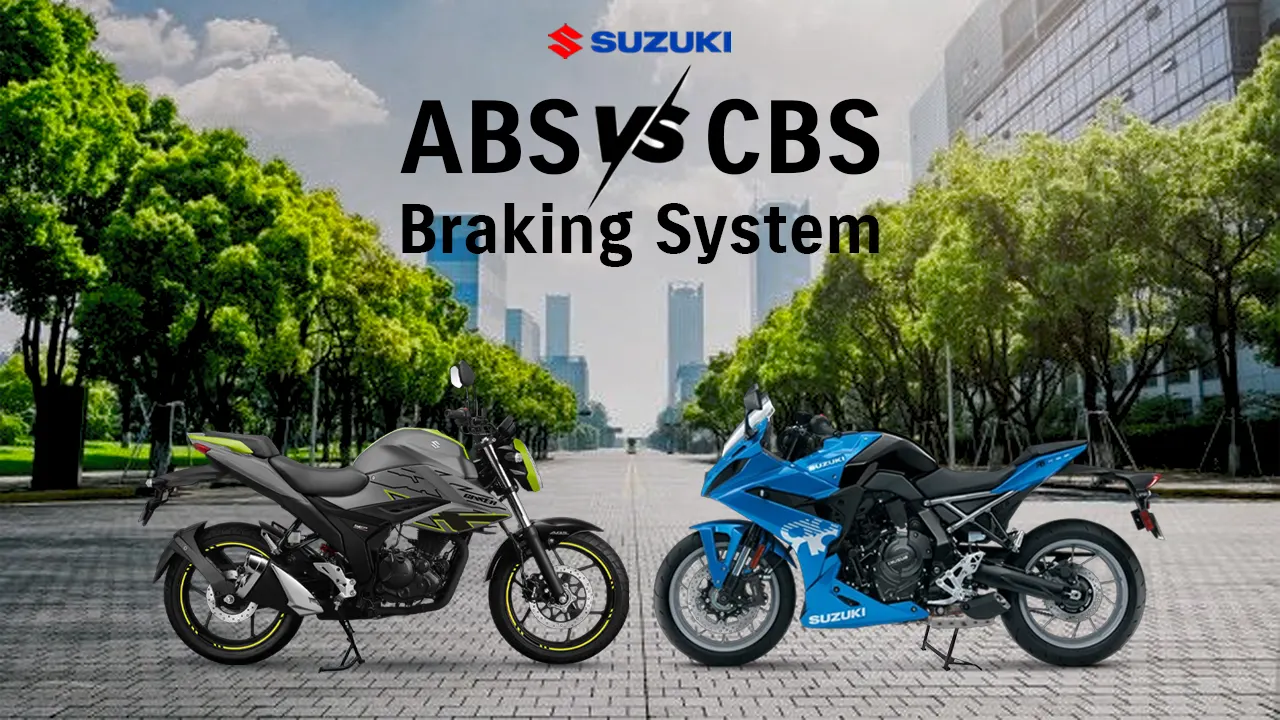
Braking is one of the most critical aspects of motorcycle safety. Speed, power, and performance matter, but they mean little if a motorcycle cannot stop safely when needed. Braking is an important safety feature that helps riders stay in control and ride with confidence in different road conditions.
Suzuki motorcycles and scooters feature advanced braking technologies such as Anti-Lock Braking System (ABS) and Combined Braking System (CBS). While these technologies enhance braking performance, they are rider-assist features and do not replace the need for safe riding practices and maintaining adequate braking distance.
Understanding how these braking systems work and where they are used can help riders to support more confident riding experiences.
Why Braking Matters for Two-wheeler
Braking on a two-wheeler is not just about slowing down; it is also about maintaining balance and staying upright. When a rider applies the brakes, several physical changes occur simultaneously:
- Weight shifts forward
- The front suspension compresses
- The rear wheel becomes lighter
Because of these dynamics, braking must be controlled carefully to maintain traction and rider stability.
This is why Suzuki integrates braking systems like ABS and CBS across different motorcycles and scooters to support braking performance and rider control, while encouraging responsible riding practices.
What is ABS (Anti-Lock Braking System)?
The Anti-Lock Braking System (ABS) is designed to support braking by preventing wheel lock-up, allowing riders to maintain stability in challenging situations.
ABS continuously monitors wheel speed and regulates brake pressure to help prevent wheel lock-up. This helps maintain traction and rider control, especially when brakes are applied suddenly or firmly, allowing for more stable braking.
For the rider, the experience remains seamless.. The system operates automatically when required, without additional rider input. The system intervenes only when braking conditions demand it.
Key Function of ABS
- Monitors front and rear wheel speed.
- Adjusts braking pressure automatically.
- Helps prevent wheel lock-up.
- Maintains available traction and rider control.
ABS is a rider-assist feature that controls braking stability, but riders should always maintain a safe braking distance and remain attentive to road conditions.
What is CBS (Combined Braking System)?
The Combined Braking System (CBS) is a braking system used in Suzuki scooters to assist braking balance.
CBS enables the rider to operate both brakes using the left brake lever.
The system is designed to:
- Allow operation of both brakes through the left lever
- Help maintain a balance between front and rear braking forces
CBS is a supplemental braking system, and riders should operate both brake levers together while maintaining proper braking distance for effective and controlled braking.
ABS vs CBS: Understanding the Difference
Both braking systems improve riding confidence but serve slightly different functions.
| Feature | ABS (Anti-Lock Braking System) | CBS (Combined Braking System) |
| Main Function | Helps prevent wheel lock-up during braking | Distributes braking force between front and rear wheels |
| Operation | Monitors wheel speed and adjusts braking pressure automatically | Allows both brakes to be applied through the left brake lever |
| Wheel Monitoring | Monitors wheel speed | Does not monitor wheel speed |
| Purpose | Maintains traction and rider control | Maintains balanced braking force |
This comparison highlights how each system supports braking performance in different ways. While both systems enhance braking performance, they are designed to assist the rider and should be used in combination with safe riding habits and proper braking awareness.
Final Thoughts
Braking systems play a crucial role in two-wheeler safety. Technologies like ABS and CBS help riders maintain control & stability during braking, supporting a confident riding experience.
- ABS helps prevent wheel lock-up and maintain traction.
- CBS helps distribute braking force between the front and rear wheels.
Suzuki integrates these braking systems across its motorcycles and scooters to support more confident riding experiences. However, as rider-assist features, they do not eliminate the need for safe riding practices, rider awareness, and maintaining adequate braking distance.
