


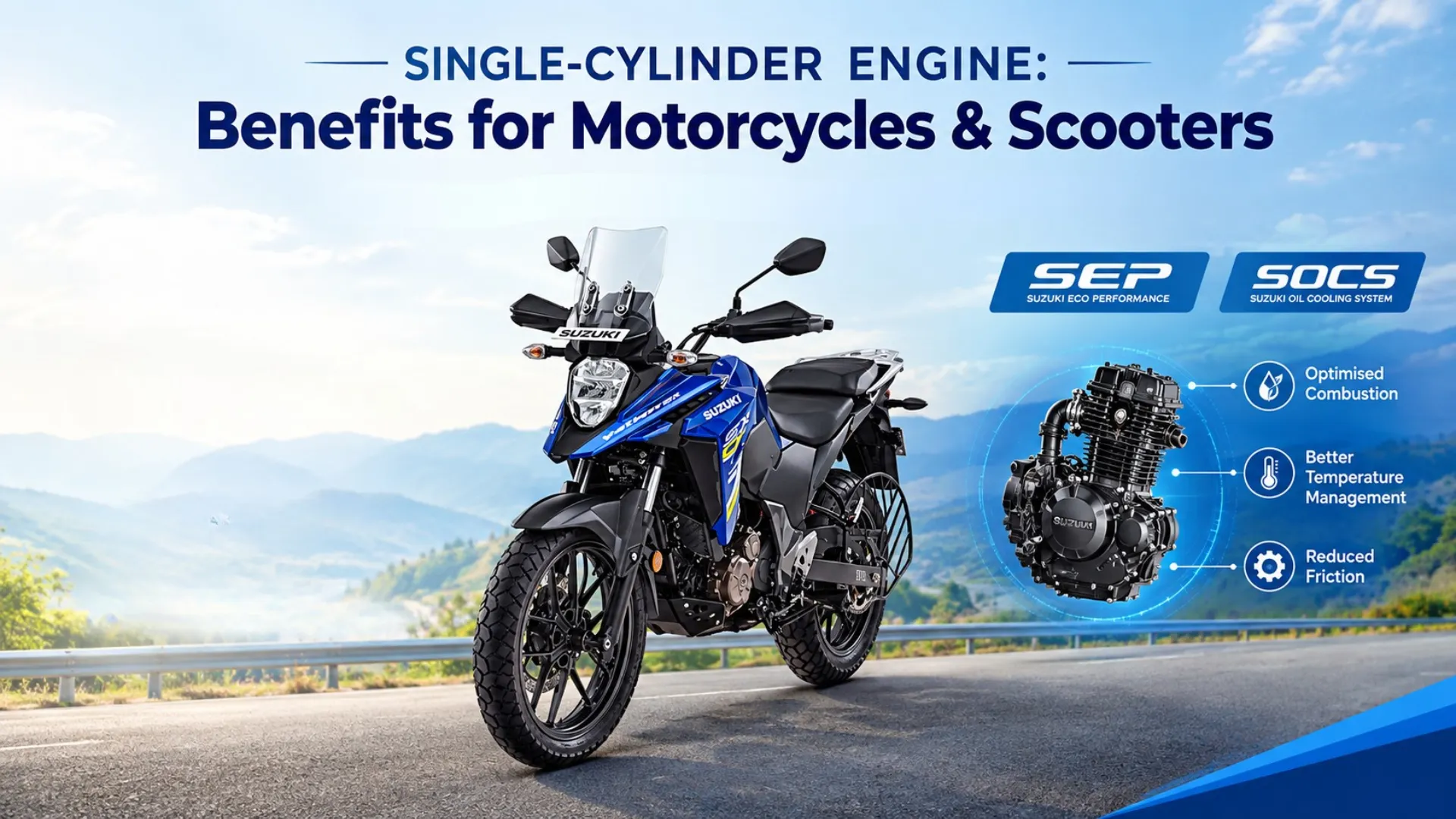
From everyday scooters to street and adventure motorcycles, single-cylinder engines are widely used across different types of two-wheelers.
Their relatively simple and compact architecture can make them a practical foundation for vehicles where packaging, manageable weight and usable performance need to be balanced.
For Indian riders, this balance can be especially relevant because everyday two-wheelers may need to handle dense city traffic and frequent stop-and-go riding as well as longer commutes and occasional highway journeys.
But the number of cylinders is only one part of the story. Engine tuning, combustion, friction reduction, cooling and fuel delivery all influence how efficiently an engine performs.
So, what makes the single-cylinder engine such a versatile choice?
What Is a Single-Cylinder Engine?
As the name suggests, a single-cylinder engine has one combustion cylinder and one piston. During combustion, pressure acts on the piston, transmitting force through the connecting rod to rotate the crankshaft and produce mechanical output.
Compared with a multi-cylinder layout designed for a similar application, a single-cylinder engine can use a more compact architecture with fewer cylinder-related components.
For motorcycles and scooters, this can contribute to:
- Compact engine and vehicle packaging
- Potential for a relatively lightweight engine package
- Fewer cylinder-related components
- Can support a compact, manageable two-wheeler design
These characteristics help explain why single-cylinder engines are used across a wide range of two-wheelers – from urban scooters and commuter-oriented motorcycles to street, touring and adventure applications.
Built Around Real-World Performance
Single-cylinder engines can be tuned for very different riding requirements.
In a scooter, engineering priorities may include smooth acceleration, fuel efficiency and responsiveness during everyday riding. A larger-capacity motorcycle can use the same basic single-cylinder concept with very different displacement, cooling, transmission and tuning to suit street, touring or adventure use.
It is important to note that a single cylinder does not automatically mean greater low-end torque or better fuel efficiency. Factors such as displacement, bore and stroke, combustion design, valve timing, intake and exhaust design, transmission or CVT settings, gearing and engine calibration all influence how an engine delivers its performance.
This flexibility helps explain why Suzuki uses single-cylinder engines across different types of two-wheelers in India, with each engine engineered according to the intended character and use of the model.
Efficiency Is More Than Engine Size
A compact engine can provide a useful foundation for efficient performance, but fuel economy depends on much more than cylinder count.
Vehicle weight, internal friction, combustion efficiency, fuel delivery, transmission, riding conditions and riding style all influence actual fuel consumption.
Modern engine development therefore focuses on reducing energy losses and making combustion more efficient – areas where technologies such as Suzuki Eco Performance (SEP) come into play.
SEP: Balancing Efficiency and Acceleration
Suzuki Eco Performance (SEP) is Suzuki’s engine development concept aimed at combining low fuel consumption with strong, responsive acceleration.
Depending on the engine and model, SEP can incorporate measures such as lightweight design, reduced friction and mechanical losses, optimised combustion, precise fuel injection and transmission or CVT calibration.
The Suzuki Access, for example, uses a 124 cm³, single-cylinder, air-cooled SEP engine producing 6.2 kW at 6,500 rpm and maximum torque of 10.2 Nm at 5,000 rpm. Suzuki highlights measures such as a revised injector mounting angle, optimised CVT settings and lower idling rpm as contributors to its acceleration response and fuel efficiency.
In practical terms, SEP demonstrates how efficiency and acceleration response can be developed together rather than treating fuel economy and everyday performance as separate objectives.
Keeping Things Cool with SOCS
Temperature management also plays an important role in engine efficiency and performance.
On the V-STROM SX, Suzuki uses the Suzuki Oil Cooling System (SOCS) with its 249cm³ single-cylinder engine, oil-cooled engine.
SOCS uses engine oil as a key part of the cooling process. Suzuki explains that the system helps the engine warm up quickly and maintain an appropriate operating temperature, supporting efficient combustion while allowing a compact and relatively lightweight engine design.
SOCS is a technology used on specific Suzuki engines and should not be considered a feature of all single-cylinder engines.
Suzuki also uses SOCS on the GIXXER 250 and GIXXER SF 250, which use a 249 cm³ single-cylinder, oil-cooled engine. This shows how the same cooling concept can support different motorcycle applications, from sporty road riding to adventure-oriented use.
Less Friction, More Efficient Operation
Inside any engine, some energy is lost through mechanical friction. Reducing these losses helps make better use of the energy produced during combustion.
On the V-STROM SX, Suzuki uses lightweight internal components and friction-reduction measures, including engineering applied to areas such as the valves, rocker arms and piston. Together with fuel injection and combustion optimisation, these measures contribute to engine efficiency and a lightweight overall package.
It demonstrates an important point: while the basic single-cylinder layout may appear simple, the engineering used to optimise it can be highly sophisticated.
What About the Trade-Offs?
Like every engine configuration, a single-cylinder engine has its limitations.
One characteristic associated with single-cylinder engines is that vibration and individual combustion pulses can be more noticeable than in some multi-cylinder layouts, particularly at certain engine speeds. Manufacturers can manage these characteristics through measures such as crankshaft and reciprocating-mass design, balancing systems, engine mounts and overall vehicle engineering.
Multi-cylinder layouts can provide smoother power delivery and may be better suited to motorcycles where high-rpm refinement or higher overall performance is a greater priority. There is therefore no single engine configuration that is best for every motorcycle.
The right configuration depends on what the two-wheeler has been designed to do.
Single-Cylinder or Multi-Cylinder?
| Feature | Single-Cylinder | Multi-Cylinder |
| Basic architecture | One cylinder; relatively compact basic layout | Two or more cylinders typically require additional components and packaging |
| Packaging | Can support a compact engine package | Usually requires more space depending on cylinder arrangement |
| Engine mass | Can be relatively lightweight for its intended application | Additional cylinders/components can increase mass, although actual weight depends on design |
| Power delivery | Individual combustion pulses may be more noticeable | More frequent combustion events can contribute to smoother power delivery |
| Vibration characteristics | Can be more noticeable at certain engine speeds | Generally smoother, depending on engine configuration and balancing |
| Typical applications | Common in scooters, commuter and street motorcycles, and lightweight adventure motorcycles | Common in larger or higher-performance motorcycles |
| Efficiency/ performance | Depends on displacement, combustion, friction, tuning, and vehicle design | Also depends on displacement, combustion, friction, tuning, and vehicle design |
How Suzuki Uses the Single-Cylinder Formula
Suzuki uses engine configurations according to the intended character and purpose of each two-wheeler.
In India, Suzuki uses Single-cylinder engines across its scooters such as the Access, Avenis and Burgman Street, as well as motorcycles including the GIXXER series and V-STROM SX.
What differs is how each engine is engineered and tuned for its intended use.
Technologies and engineering approaches such as SEP, fuel injection and, friction reduction on selected models, SOCS help Suzuki tailor these engines for the efficiency, performance, packaging and riding characteristics intended for each model.
Key Takeaways
- Single-cylinder engines can provide a compact and relatively lightweight foundation for many motorcycles and scooters.
- Cylinder count alone does not determine torque, fuel efficiency or overall vehicle performance.
- Suzuki Eco Performance (SEP) focuses on combining low fuel consumption with responsive acceleration through optimised engine design.
- Suzuki Oil Cooling System (SOCS) supports effective temperature management and compact engine packaging on selected Suzuki motorcycles.
- Single- and multi-cylinder engines have different characteristics; the appropriate configuration depends on the intended use and overall engineering of the two-wheeler.
Final Thoughts
Single-cylinder engines remain an important part of two-wheeler engineering because their compact architecture can be adapted to very different riding requirements. However, cylinder count alone does not determine whether an engine will be efficient, responsive, smooth or suitable for a particular rider.
Suzuki’s Indian lineup demonstrates this versatility from 124 cm³ scooter engines developed around everyday efficiency and usability to 249 cm³ SOCS equipped motorcycle engines designed for different street, sport and adventure applications.
Technologies such as SEP and SOCS further demonstrate how Suzuki tailors the engine package according to each model’s intended purpose. When choosing a motorcycle or scooter, riders should therefore consider the complete vehicle, including engine character, transmission, weight, chassis, intended use and riding environment rather than selecting a two-wheeler based on cylinder count alone.
