


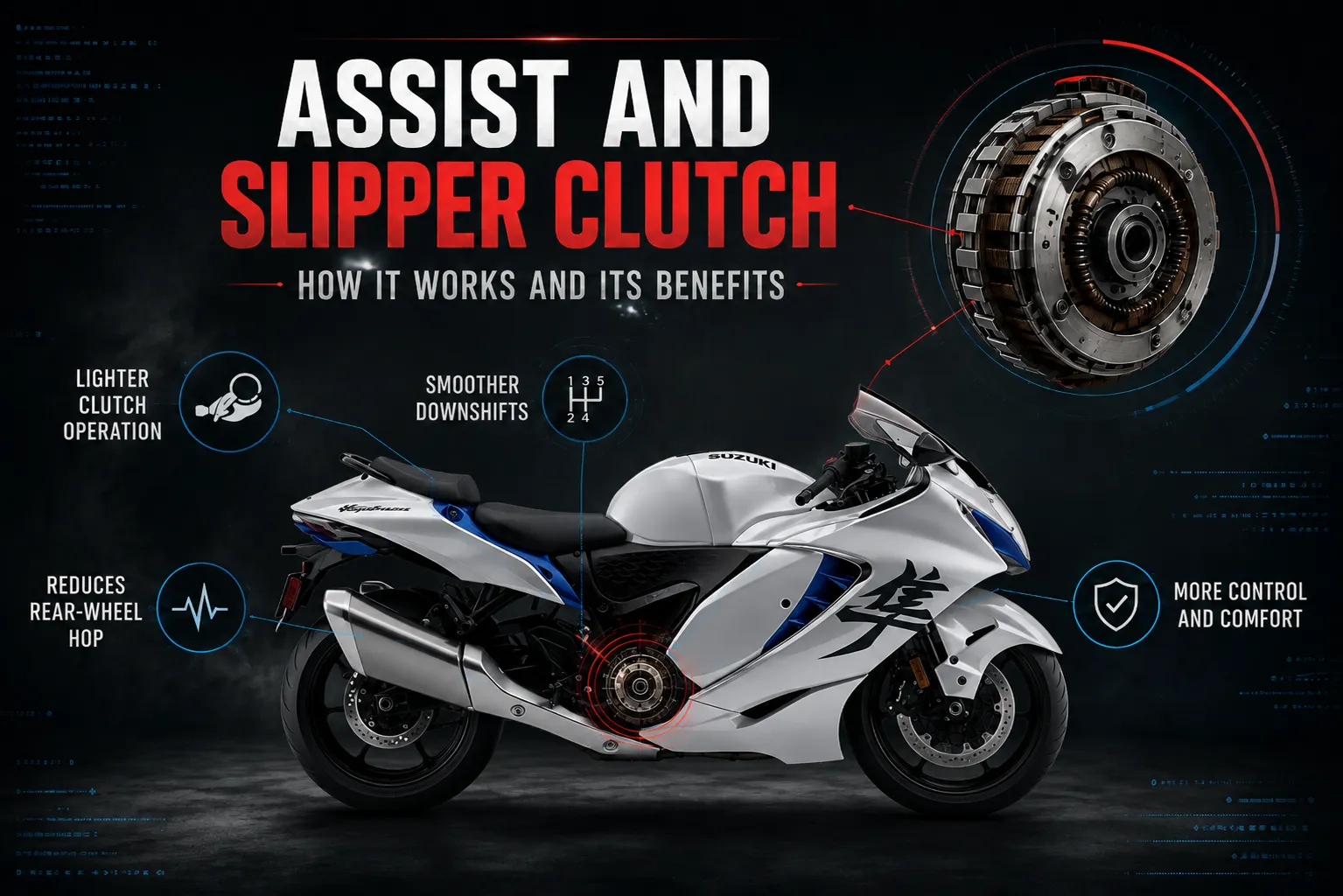
An assist and slipper clutch is a motorcycle clutch system designed to make clutch operation easier and help provide better control during aggressive downshifts.
It combines two functions:
- Assist function: Helps reduce clutch lever effort.
- Slipper function: Helps manage excessive engine braking and rear-wheel hop during aggressive downshifts.
Together, these functions can make everyday riding more comfortable and performance-oriented riding more controlled.
What Is an Assist and Slipper Clutch?
A typical multi-plate motorcycle clutch uses friction plates, steel plates and clutch springs to transmit engine torque to the transmission.
An assist and slipper clutch adds a mechanical assist-and-slipper mechanism that changes the effective clamping force on the clutch plates depending on the direction of torque.
When engine drive torque is transmitted through the clutch, the assist mechanism helps increase clutch clamping force. This can allow lighter clutch springs to be used while maintaining the required clamping force, helping reduce clutch lever effort.
During strong deceleration or rapid downshifting, back torque from the rear wheel can act through the transmission toward the engine. The slipper mechanism helps limit excessive back torque by allowing a controlled amount of clutch slip.
In simple terms:
- Assist = reduced clutch lever effort.
- Slipper = controlled management of excessive back torque during downshifts.
How Does the Assist Function Work?
When the engine is driving the motorcycle, drive torque passes through the clutch to the transmission. The assist mechanism uses this torque to help increase the clamping force holding the clutch plates together.
Because the mechanism contributes to the required clamping force, lighter clutch springs can be used while still maintaining effective power transmission.
This helps provide lighter clutch lever action, which can be particularly useful during city riding and stop-and-go traffic.
How Does a Slipper Clutch Work?
During normal engine drive, torque is transmitted from:
Engine → Clutch → Transmission → Rear Wheel
During strong deceleration or a rapid downshift, back torque can act in the opposite direction:
Rear Wheel → Transmission → Clutch → Engine
If the rider selects a lower gear while travelling at speed, engine speed must rise to match the road speed and the lower gear ratio. If this speed difference is large or abrupt, it can create strong back torque and engine braking that may unsettle the rear wheel.
When sufficient back torque acts through the clutch, the slipper mechanism reduces the effective clamping force on the clutch plates. This allows controlled clutch slip and helps moderate the sudden back-torque load.
The slipper function does not eliminate engine braking; it helps moderate excessive back torque when required. As a result, it can help reduce rear-wheel hop or instability caused by excessive back torque and make rapid downshifts smoother.
Assist Clutch vs Slipper Clutch
| Feature | Assist Function | Slipper Function |
| Main purpose | Reduce clutch lever effort | Manage excessive back torque |
| Primarily acts during | Engine drive torque | Back torque during deceleration / downshifting |
| Main rider benefit | Lighter clutch operation | Smoother, more controlled downshifts |
| Can help reduce rear-wheel hop | Not directly | Yes |
| Increases engine power | No | No |
Although they perform different functions, both can be integrated into the same clutch system.
Benefits of an Assist and Slipper Clutch
1. Lighter Clutch Operation
The assist mechanism helps reduce clutch lever effort, making repeated clutch operation easier. This can be especially useful in urban traffic.
2. Smoother Downshifts
The slipper function helps moderate excessive back torque and the sudden engine-braking effect that can occur during rapid downshifts.
3. Helps Reduce Rear-Wheel Hop
Excessive back torque can unsettle the rear wheel. Controlled clutch slip can help reduce rear-wheel hop or instability caused by this sudden load.
4. Smoother Downshifts Before Corners
Riders may brake and downshift before entering a corner. By helping manage excessive back torque during downshifts, a slipper clutch can make this transition smoother and reduce sudden driveline disturbance.
5. Reduced Rider Fatigue
A lighter clutch action can make frequent gear changes more comfortable, particularly during commuting or longer rides.
Is an Assist and Slipper Clutch Useful for Daily Riding?
Yes. In everyday city riding and stop-and-go traffic, riders may notice the assist function more because repeated clutch operation can become tiring. The slipper function is generally more noticeable during rapid downshifts or stronger deceleration.
This makes an assist and slipper clutch useful across different riding conditions rather than only for performance riding.
Does a Slipper Clutch Make a Motorcycle Faster?
No. A slipper clutch does not increase horsepower, torque or engine performance.
Its primary purpose is to help manage excessive back torque during downshifts, contributing to smoother and more controlled deceleration.
Assist and Slipper Clutch vs Quickshifter
An assist and slipper clutch and a quickshifter perform different functions.
Assist and Slipper Clutch
This is primarily a mechanical clutch technology that helps:
- Reduce clutch lever effort
- Manage excessive back torque
- Help reduce rear-wheel hop during rapid downshifts
Quickshifter
- A quickshifter assists the gear-changing process and, depending on the system design, can allow gear changes without manually operating the clutch lever while the motorcycle is in motion.
- A bi-directional quickshifter supports both upshifts and downshifts. Suzuki refers to its system as the Bi-directional Quick Shift System.
- The two systems therefore complement rather than replace each other.
How Suzuki Uses Assist and Slipper Clutch Technology
Suzuki applies assist-and-slipper clutch technology across several of its current big-bike models in India. Depending on the model, Suzuki refers to the system as an assist & slipper clutch or the Suzuki Clutch Assist System (SCAS).
Suzuki Hayabusa
The Suzuki Hayabusa uses an assist & slipper clutch alongside its Bi-directional Quick Shift System. Suzuki states that the clutch helps ensure smoother shifts, while the Quick Shift System allows rapid upshifts and downshifts without the rider having to operate the clutch or throttle during the shift.
Suzuki GSX-8R
The Suzuki GSX-8R is equipped with the Suzuki Clutch Assist System (SCAS) and a Bi-directional Quick Shift System. Suzuki Motorcycle India describes SCAS as helping reduce fatigue on long rides and contributing to smoother shifting.
Suzuki V-Strom 800 DE
The Suzuki V-STROM 800DE also uses the Suzuki Clutch Assist System (SCAS).
Suzuki Motorcycle India states that the system helps reduce fatigue on long rides and contributes to smoother shifting, while the motorcycle’s Bi-directional Quick Shift System supports clutchless upshifts and downshifts while riding. SCAS and the Bi-directional Quick Shift System perform different roles.
SCAS is a mechanical clutch system that helps manage clutch effort and back torque, while the Quick Shift System assists the gear-changing process. The two technologies can therefore work together to support smoother shifting and reduced rider effort.
Does a Slipper Clutch Prevent Rear-Wheel Skidding?
No. A slipper clutch can help reduce rear-wheel instability caused by excessive back torque during rapid downshifts, but it cannot prevent every type of rear-wheel slide or loss of traction.
Rear-wheel grip also depends on factors such as:
- Road conditions
- Tyre condition and pressure
- Braking input
- Motorcycle speed
- Lean angle
- Weather
- Rider inputs
A slipper clutch should therefore be viewed as a mechanical clutch technology that supports smoother driveline behaviour, not as a replacement for appropriate speed, correct gear selection and proper riding technique.
Final Thoughts
An assist and slipper clutch combines two complementary clutch functions in one system. The assist function helps reduce clutch lever effort, while the slipper function helps manage excessive back torque during rapid downshifts or strong deceleration.
For everyday riders, this can mean lighter clutch operation in traffic. During sportier riding, the slipper function can help provide smoother and more controlled downshifts.
Suzuki big bikes such as the Hayabusa, GSX-8R and V-STROM 800DE combine assist-and-slipper clutch functionality with a Bi-directional Quick Shift System, demonstrating how mechanical clutch technology and electronic shift assistance can complement each other.
An assist and slipper clutch is designed to support, not replace, appropriate speed, correct gear selection and proper riding technique.
